AEO vs GEO vs SEO: How They Differ and Which Your Business Needs
AIRIX Team··17 min read
Want to know your AI visibility score?
We'll check if ChatGPT, Gemini, and Claude can actually read your website. Takes 30 seconds.
By submitting, you agree to receive your report and occasional emails. Unsubscribe anytime.
Ready to see where you stand?
Get a free AI crawlability audit - robots.txt, SSR, llms.txt, structured data and more. Sent straight to your inbox.
By submitting, you agree to receive your report and occasional emails. Unsubscribe anytime.
AEO vs GEO vs SEO: How They Differ and Which Your Business Needs in 2026
Search has fractured. The same buyer researching your product might ask Google, then ask ChatGPT, then ask Perplexity, and never click a single traditional link. Meanwhile, 60% of all Google searches already end without a click (Bain & Company / SparkToro, 2025), up from 26% in 2022. Three distinct disciplines have emerged to address each channel: SEO, AEO, and GEO.
Most businesses know the acronyms. Almost none have a clear framework for choosing between them.
This article gives you that framework, including a diagnostic matrix, a measurement guide for AI-native channels, and a sequenced strategy that layers all three.
Key Takeaways
SEO, AEO, and GEO target different surfaces: Google rankings, voice/answer boxes, and generative AI responses.
Only 17-38% of Google top-10 rankings overlap with AI Overview citations in early 2026 (BrightEdge / Mersel AI, 2026).
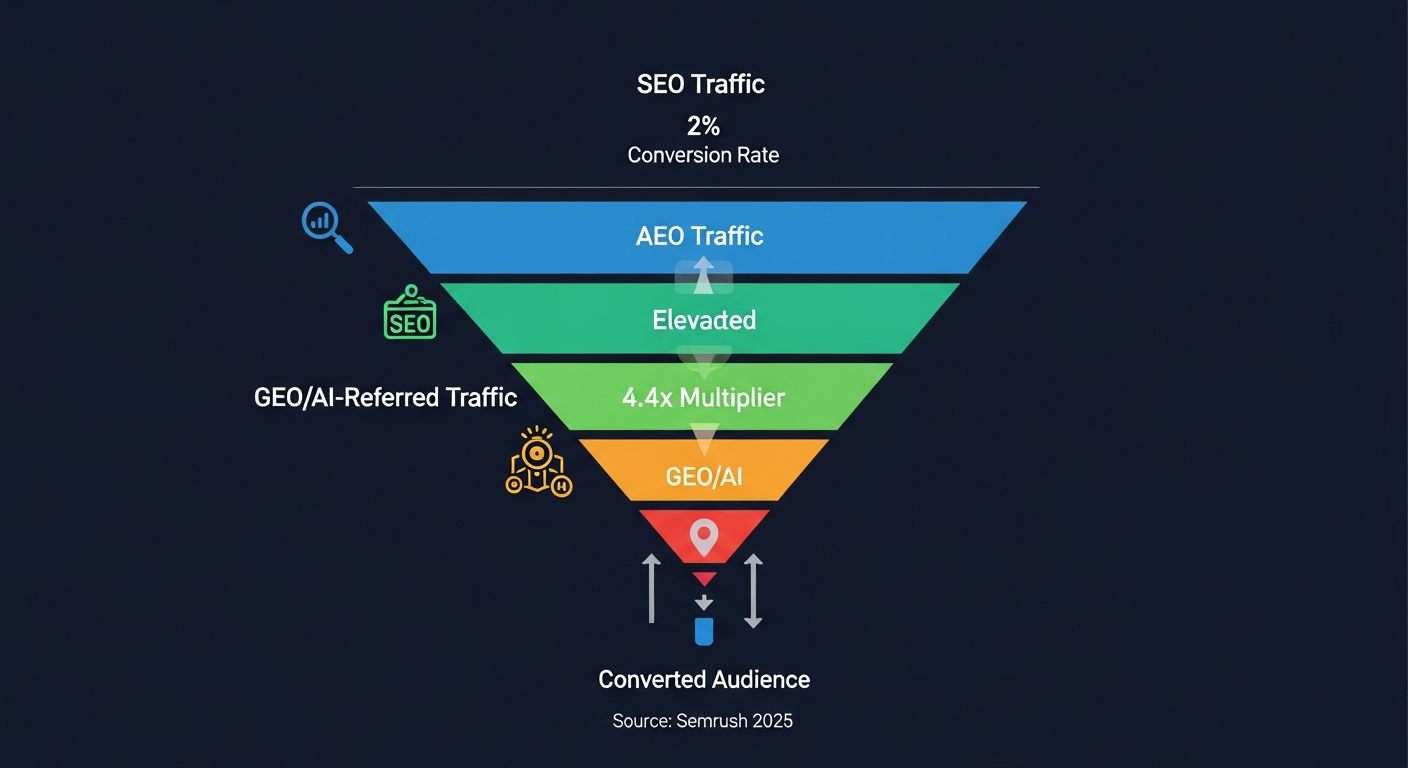
AI-referred visitors convert at 4.4x the rate of standard organic visitors (Semrush, 2025).
The most effective approach layers all three into a unified "Search Everywhere" stack.
47% of brands have no GEO strategy yet, making early adoption a real competitive edge.
What Are SEO, AEO, and GEO? A Plain-English Breakdown
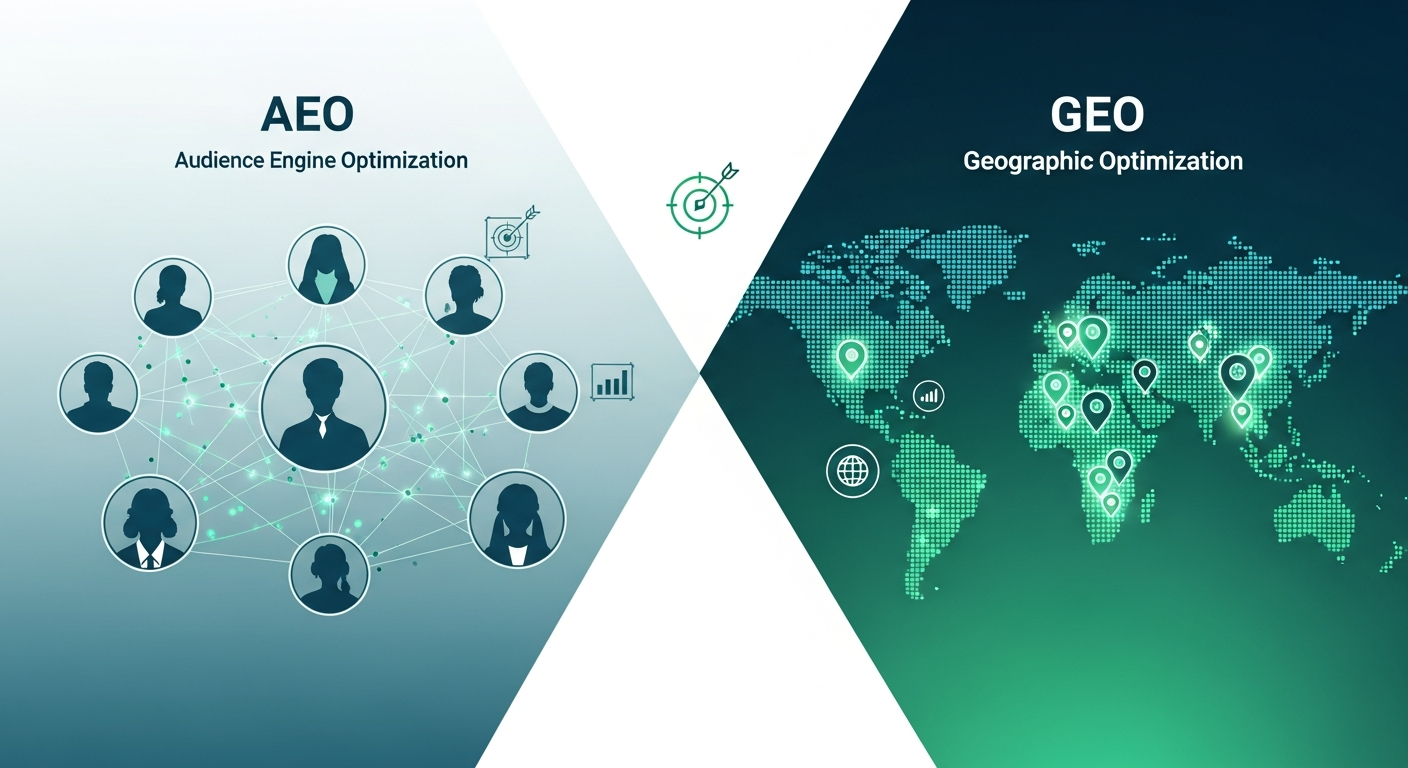
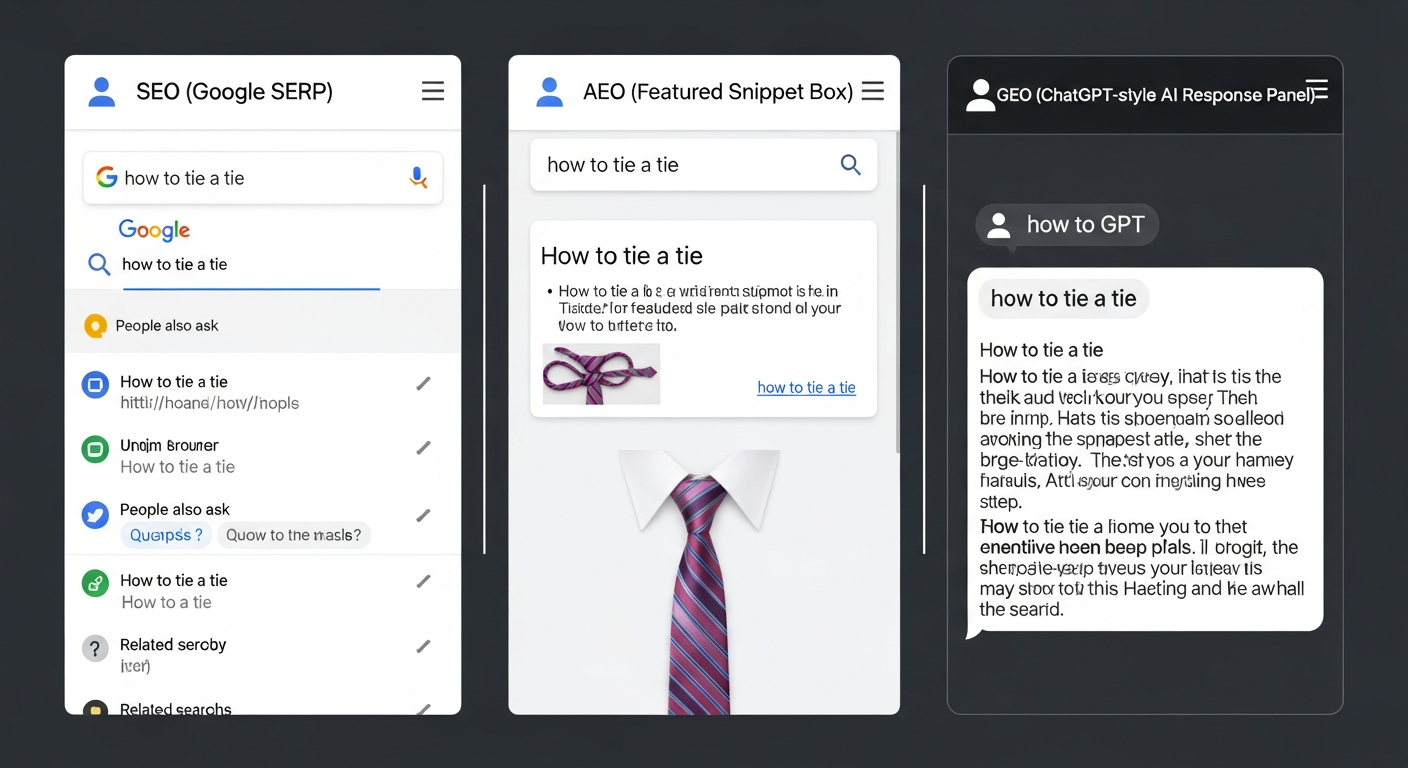
SEO (Search Engine Optimization) is the practice of ranking web pages in traditional search results like Google and Bing. It relies on backlinks, technical structure, and keyword relevance. SEO has been the dominant digital marketing channel since the late 1990s.
LLM Traffic Conversion Rate vs. Google Organic (2025)Overlap Between Google Top-10 Rankings and AI Overview Citations (Mid-2025 to Early 2026)
AEO (Answer Engine Optimization) targets direct-answer surfaces: featured snippets, Google's "People Also Ask" boxes, and voice assistants like Siri and Alexa. The goal is to be the single extracted answer, not just a ranked result.
GEO (Generative Engine Optimization) is the newest discipline. It focuses on getting your content cited inside AI-generated responses from ChatGPT, Perplexity, Google AI Overviews, and Gemini. GEO requires a different content architecture than SEO or AEO.
Does Ranking #1 on Google Still Guarantee AI Visibility?
Ranking #1 on Google no longer guarantees visibility in AI search results. Only 17-38% of Google top-10 organic rankings overlap with AI Overview citations as of early 2026, down sharply from roughly 75% overlap in mid-2025 (BrightEdge / Mersel AI, 2026). SEO rank and AI visibility are rapidly decoupling, meaning a separate optimization strategy is required for each channel.
This is the core misunderstanding trapping most marketing teams in 2026. They assume strong SEO performance cascades into AI citations.
This decoupling creates an asymmetric opportunity. A mid-sized brand with clear, structured, well-cited content can outrank an enterprise competitor in AI responses even if they rank page 3 in Google. That was effectively impossible in traditional SEO.
Organic CTR Decline When Google AI Overview Is Present (vs. Not Present)
Which Strategy Drives Better ROI? A Conversion Quality Comparison
Here is why the conversion difference exists. When a user reads an AI-generated response, they are further along in their research process. The AI has already synthesized multiple sources and delivered a conclusion. Users who then click through to a cited source arrive pre-qualified and higher-intent.
Consider the funnel math. If your organic search converts at 2%, an equivalent volume of AI-referred traffic would convert at roughly 8.8%. At scale, that quality gap dwarfs incremental SEO gains from moving from rank 4 to rank 2.
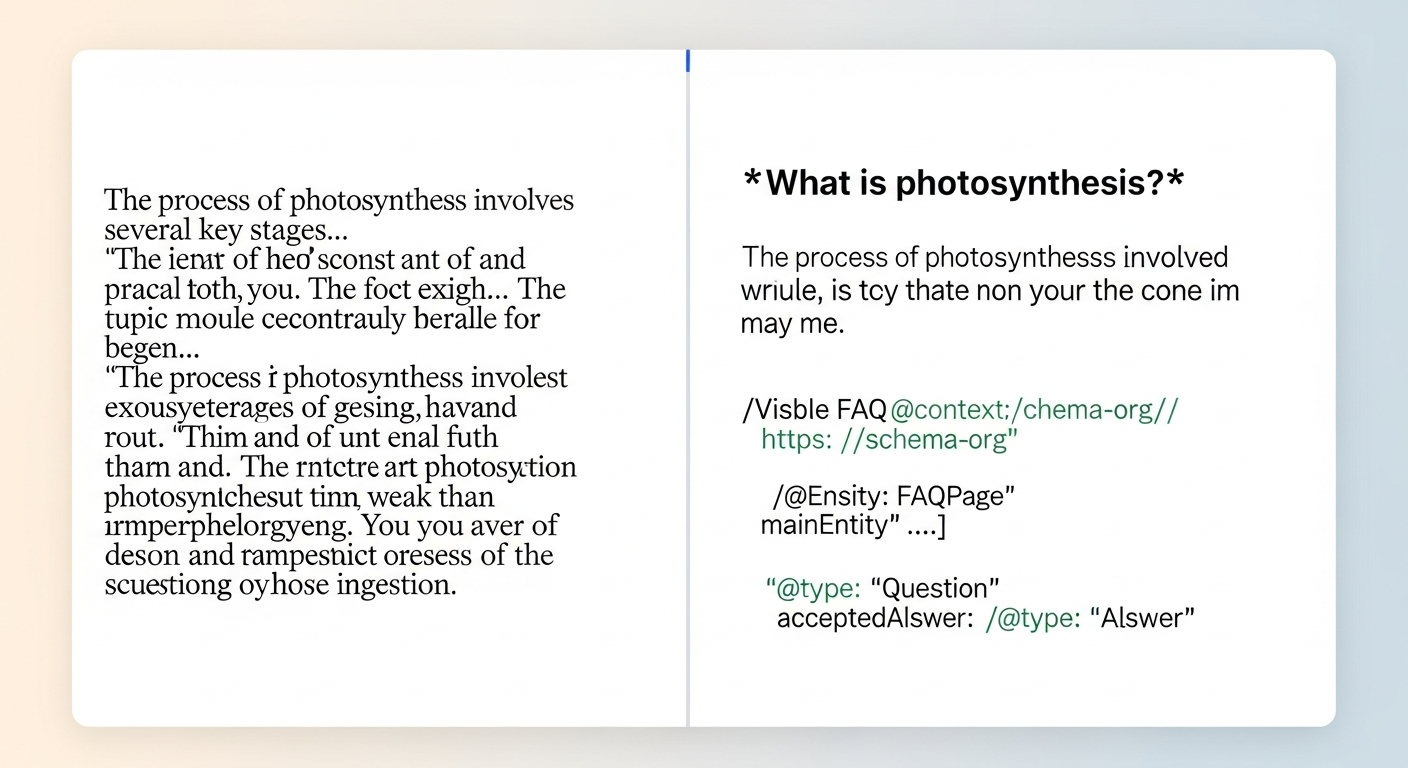
Pages optimized for AEO follow a "question, then answer" structure. The answer appears within the first 50-60 words. Schema markup (FAQ, HowTo, Speakable) signals extractable content to crawlers.
Which Strategy Does Your Business Actually Need? A Diagnostic Framework
If you are a B2B SaaS or professional services brand: GEO is your highest-leverage investment. Your buyers research extensively before contacting sales. They ask ChatGPT and Perplexity comparative questions like "best [category] tool for [use case]." Being cited in those responses puts you in consideration before you even know a prospect exists.
If you sell physical products or local services: AEO is your fastest win. Voice search and featured snippets drive near-purchase queries. Get your product specs, pricing, and FAQs into structured schema immediately.
If you are an e-commerce brand with strong existing domain authority: Protect your SEO base first, then layer AEO for product and category pages, then build GEO for comparison and "best of" content.
If you are an early-stage brand with limited domain authority: GEO levels the playing field. You can earn AI citations faster than you can build backlinks.
Share of Google Searches Ending Without a Click (2025)
The mistake most teams make is treating these as mutually exclusive options. The correct sequencing is a layered stack: SEO as foundation, AEO as structure, GEO as citation reach.
How Do You Measure GEO and AEO Performance?
This is the measurement gap almost no competitor content addresses. Google Search Console does not report AI Overview attribution. Standard rank trackers miss AI-native citation data entirely.
Here is what to track instead:
For GEO:
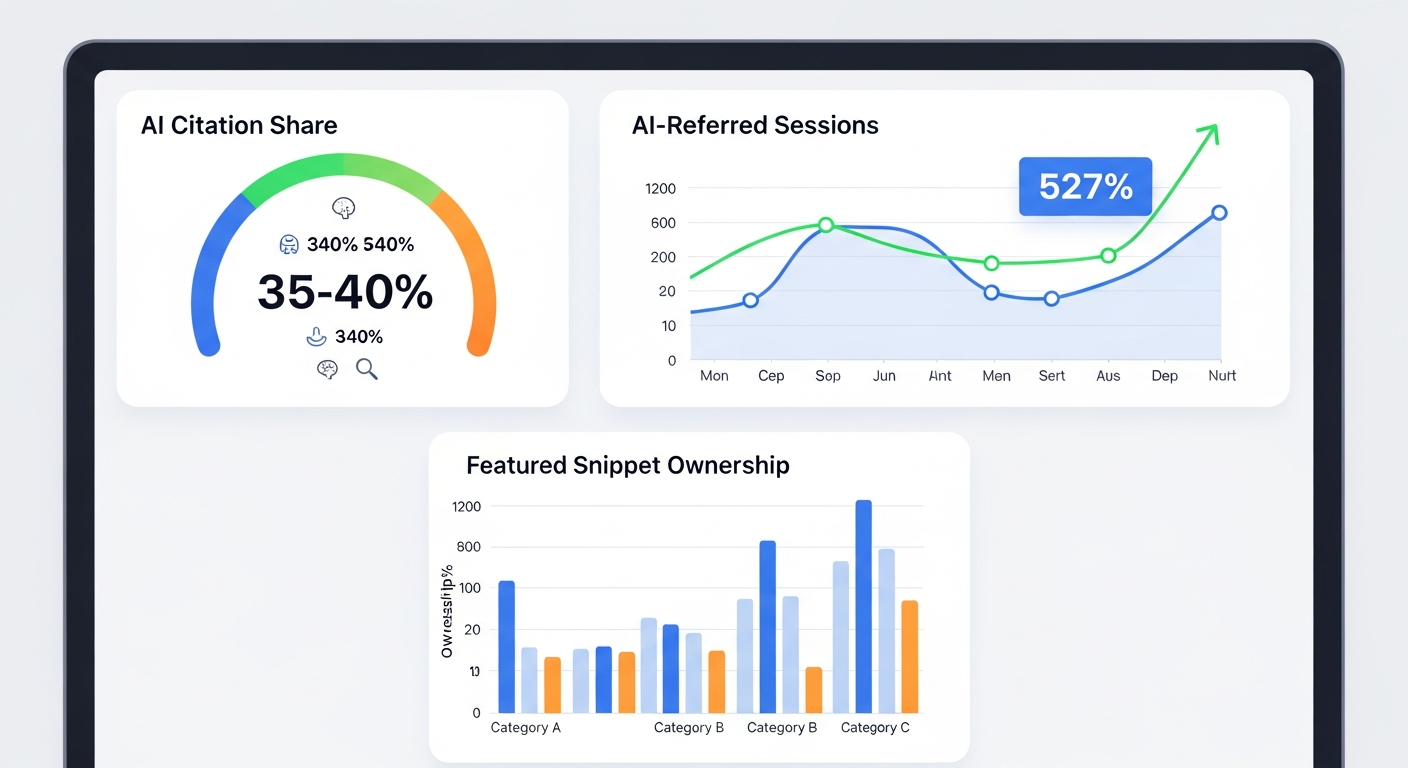
AI citation share: How often does your brand or content appear when target queries are run in ChatGPT, Perplexity, and Gemini? This requires systematic prompt monitoring, either manually or via dedicated AI visibility tools.
AI-referred sessions in GA4: Filter referral traffic from chat.openai.com, perplexity.ai, and gemini.google.com. Track separately from organic.
Share of Voice in AI responses: Among a defined query set, what percentage of responses mention your brand versus competitors?
For AEO:
Featured snippet ownership rate: Track via Semrush or Ahrefs position 0 monitoring.
PAA appearance rate: How many of your target questions appear in "People Also Ask" boxes?
Zero-click impression share: GSC impressions on queries where you appear but CTR is near zero may indicate AEO placement.
Not sure where your brand currently stands in AI responses? Check if AI can find you before auditing your strategy.
Is Traditional SEO Dying? The Honest Answer
No. But it is shrinking as a percentage of total search-driven revenue. The honest framing is not "SEO is dead" but rather "SEO's share of the search opportunity has contracted."
The solution is not to abandon SEO. Strong domain authority remains an input signal for both AEO and GEO performance. Rather, the solution is to expand your definition of search visibility beyond blue-link rankings.
Q: What is the main difference between AEO, GEO, and SEO?
SEO targets ranked blue-link results in Google and Bing using backlinks and keyword signals. AEO targets direct-answer surfaces like featured snippets and voice assistants using structured Q&A content and schema markup. GEO targets AI-generated responses in ChatGPT, Perplexity, and Google AI Overviews using citation signals, fluency, and topical authority. All three are distinct optimization channels with different ranking factors and measurement approaches.
Q: Does ranking #1 on Google mean I will appear in AI search results?
Not reliably. As of early 2026, only 17-38% of Google top-10 rankings overlap with AI Overview citations (BrightEdge / Mersel AI, 2026), down from roughly 75% in mid-2025. AI systems select sources based on clarity and citability rather than link equity. A strong SEO ranking does not automatically translate to AI visibility, and the gap is widening.
Q: Which strategy has the highest ROI for B2B companies?
GEO generally delivers the highest ROI for B2B brands. AI-referred traffic converts at 4.4x the rate of standard organic visitors (Semrush, 2025), and B2B buyers disproportionately use ChatGPT and Perplexity for vendor research. Early AEO adopters also capture 3.4x more AI search traffic than non-adopters (TNGShopper, 2025), compounding the advantage.
Q: How do I track GEO performance if Google Search Console does not show AI data?
Track three new KPIs: AI citation share (run target queries in ChatGPT, Perplexity, and Gemini systematically), AI-referred sessions filtered by referral source in GA4, and Share of Voice in AI responses across a defined query set. Dedicated AI visibility platforms can automate citation monitoring across multiple LLMs simultaneously, which is impractical to do manually at scale.
Q: Should I stop investing in SEO and shift entirely to GEO?
No. SEO domain authority remains an indirect input signal for both AEO and GEO performance. The right approach is layered: maintain your SEO foundation, restructure high-traffic content for AEO extraction, and build GEO citation signals for awareness-stage and comparative content. The global AI search market is growing at 27.3% CAGR (Precedence Research, 2025), but traditional search still handles billions of daily queries.
Conclusion: Build a Search Everywhere Stack, Not a Single Strategy
Search has permanently split into three distinct surfaces. Each rewards different content behaviors, uses different ranking signals, and requires different measurement tools.
The businesses that win in 2026 are not choosing between SEO, AEO, and GEO. They are sequencing them: SEO as the authority foundation, AEO as the structural layer that captures zero-click intent, and GEO as the citation reach layer that earns presence in AI-generated responses.
With 58% of users already using AI tools for product discovery (Capgemini, 2025) and AI sessions growing 527% year-over-year, the measurement gap is the most urgent problem to solve. You cannot optimize what you cannot see.
AIRIX is built to close that gap. It monitors your brand's citation presence across ChatGPT, Perplexity, Gemini, and Google AI Overviews, tracking the exact queries where you appear, where you do not, and which competitors are getting cited instead. Check your AI visibility score and see where your brand stands across all three channels today.