What Is Answer Engine Optimization? The Complete 2026 Guide
AIRIX Team··22 min read
Want to know your AI visibility score?
We'll check if ChatGPT, Gemini, and Claude can actually read your website. Takes 30 seconds.
By submitting, you agree to receive your report and occasional emails. Unsubscribe anytime.
Ready to see where you stand?
Get a free AI crawlability audit - robots.txt, SSR, llms.txt, structured data and more. Sent straight to your inbox.
By submitting, you agree to receive your report and occasional emails. Unsubscribe anytime.
Over 65% of Google searches now end without a single click (Superprompt.com citing Semrush/Similarweb, 2026). ChatGPT has 800 million weekly active users (OpenAI via RevvGrowth, 2025). Buyers are researching your product right now, on AI platforms, and most brands are completely invisible to them.
Answer engine optimization (AEO) is the discipline that changes that. It is how you get your content cited, quoted, and recommended by AI systems, not just ranked by search engines. This guide covers everything you need to know in 2026.
Key Takeaways
AEO optimizes content for AI citation, not just keyword rankings
Zero-click searches now exceed 65%, making AEO critical for visibility
Pages with FAQ schema are 3.2x more likely to appear in AI Overviews
AI-referred traffic converts at 4.4x the rate of standard organic traffic
AEO and SEO are complementary strategies, not competing ones
What Is Answer Engine Optimization?
Answer engine optimization (AEO) is the practice of structuring content so AI systems, including Google AI Overviews, ChatGPT, Perplexity, and Gemini, can extract, cite, and surface it as a direct answer to user queries. As of 2026, over 54% of U.S. Google searches trigger an AI Overview (Ahrefs cited by Bullseye Strategy, 2025), making AEO-ready content a baseline requirement for organic visibility.
AI-Referred Session Growth & Citation Impact
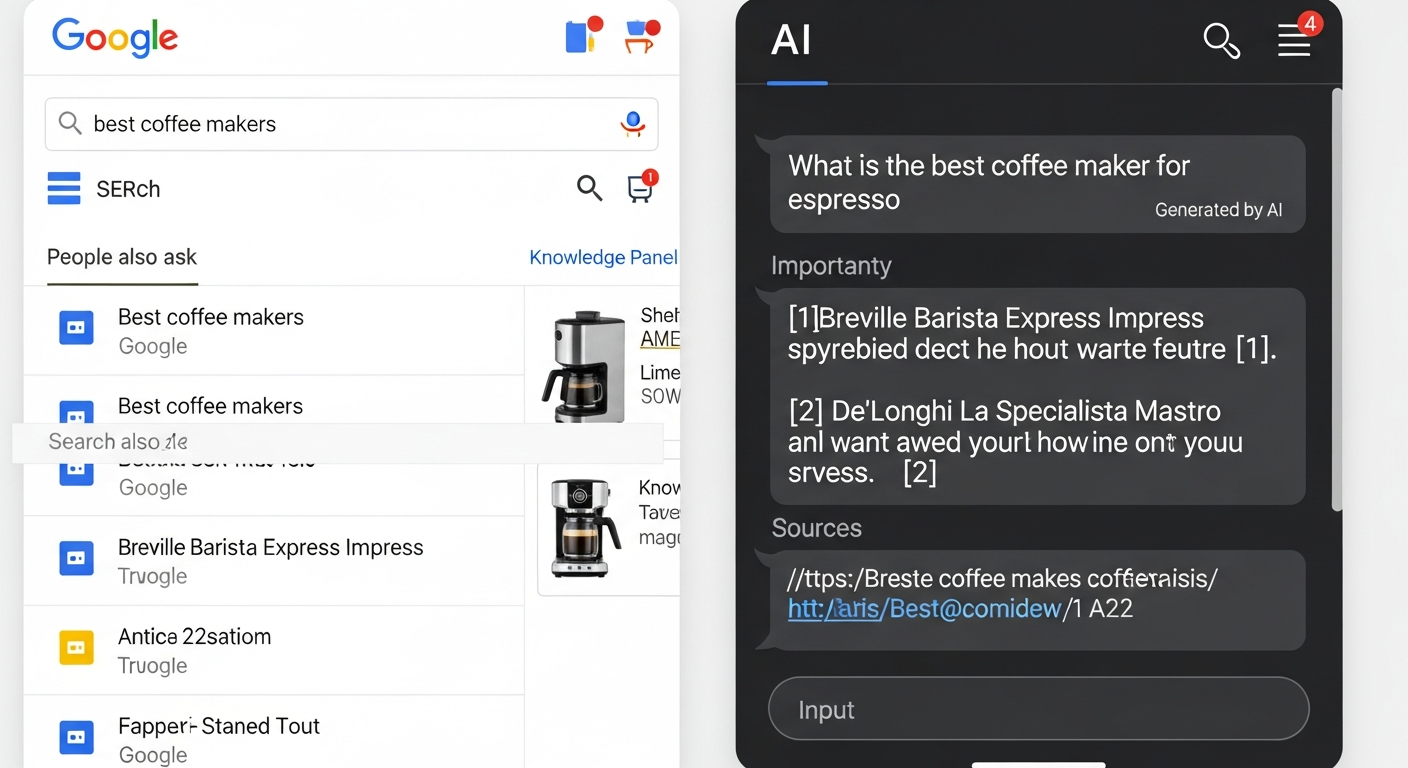
Traditional SEO wins the click. AEO wins the citation.
Where SEO focuses on ranking signals like backlinks, domain authority, and keyword density, AEO focuses on structural clarity, entity authority, and answer completeness. The goal is not to be the tenth blue link. The goal is to be the answer the AI reads aloud.
Citation Capsule: Answer engine optimization is the practice of structuring content for extraction by AI systems such as ChatGPT, Google AI Overviews, and Perplexity. Over 54% of U.S. Google searches now trigger an AI Overview (Ahrefs cited by Bullseye Strategy, 2025), making AEO a baseline visibility requirement for any content strategy in 2026.
Why Zero-Click Searches Are Rewriting the Rules
Zero-click searches hit 65%+ in Q1 2026, up from 56% before AI Overviews launched (Similarweb via Search Engine Roundtable, 2025). That 13-point jump in one year is not a trend. It is a structural shift in how people get information. If your strategy depends entirely on clicks, you are optimizing for a shrinking pool of traffic.
The mechanism is straightforward. AI systems read your content, synthesize an answer, and deliver it directly in the interface. The user gets what they need. They never visit your site.
This is not a problem you can outrank. It requires a different approach entirely.
The brands that understand this are not mourning lost clicks. They are investing in being the source the AI cites. When AI cites you, it attributes authority to your brand, even if the user never clicks through. That attribution builds trust before the first visit ever happens.
Zero-Click Search Rate Growth (2024–2026)
This 13-point acceleration in under 12 months reflects a structural shift driven by AI-generated responses that eliminate the need for users to click through to source websites.
How Is AEO Different From SEO?
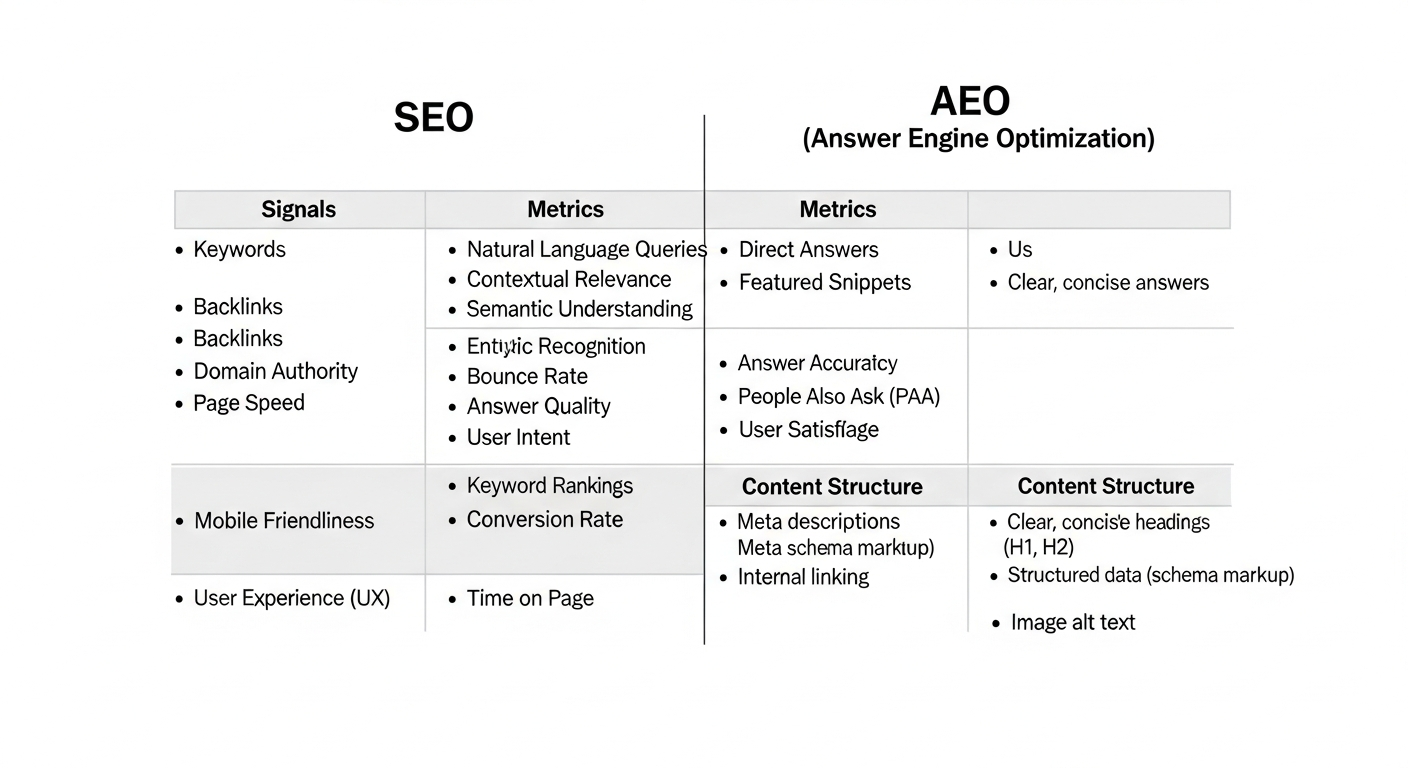
AEO and SEO are not the same discipline, but they are not opposing forces either. SEO optimizes for ranking signals that determine page position. AEO optimizes for extraction signals that determine whether an AI system chooses your content as its source. Both matter, and they work best together.
Here is where they diverge tactically:
The Core Difference in Intent
Traditional search queries average 3.37 words. The average ChatGPT prompt is 23 words (The Growth Memo via HubSpot, 2025). That six-fold difference in query length reflects a fundamental change in user intent. People are not searching for pages. They are asking questions that require synthesized, expert-level answers.
SEO content is designed to attract a crawler. AEO content is designed to satisfy a reasoning model.
Key Tactical Differences
Dimension
SEO Focus
AEO Focus
Primary signal
Backlinks, authority
Structured clarity, entity definition
Content format
Long-form, keyword-optimized
Question-answer pairs, FAQ schema
Success metric
Rankings, organic traffic
AI citations, prompt coverage
Query type
Short-tail keywords
Conversational, complex questions
Technical priority
Core Web Vitals
Schema markup, static HTML rendering
Citation Capsule: The average ChatGPT prompt is 23 words versus only 3.37 words for a traditional Google search (The Growth Memo via HubSpot, 2025). This difference illustrates why AEO and SEO require distinct content architectures: AEO content must satisfy complex conversational queries, while traditional SEO content targets shorter keyword-driven searches.
What Is the Difference Between AEO and GEO?
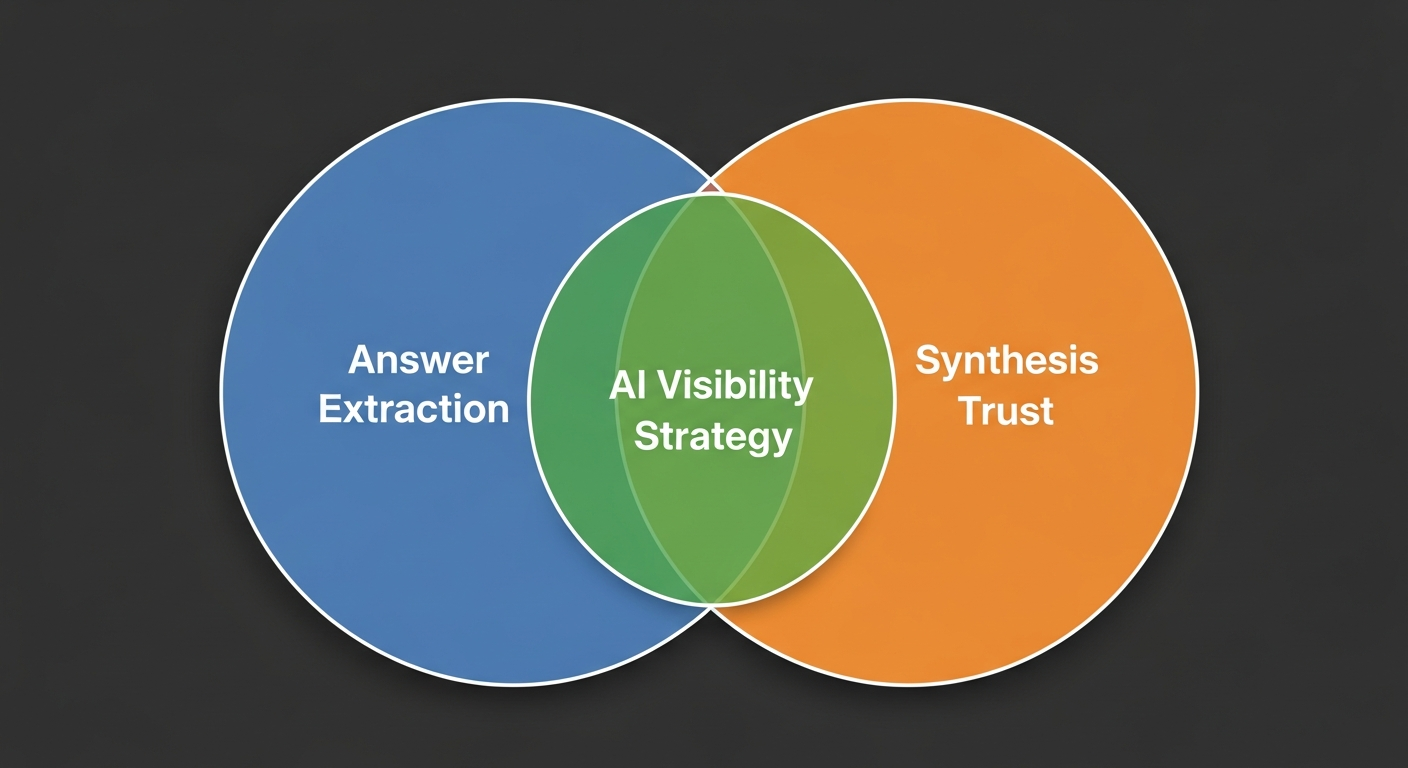
Most guides treat AEO and GEO (generative engine optimization) as synonyms. They are not. Conflating them is a strategic mistake that leads to diluted tactics and missed opportunities. This is one of the clearest gaps in the current content landscape, and understanding the distinction gives practitioners a real edge.
AEO is about answer extraction. The goal is to have AI systems pull a specific, self-contained answer from your content. Think FAQ schema, definition blocks, structured how-to content. You are making it easy for the AI to quote you directly.
GEO is about synthesis trust. The goal is to be included in AI-generated summaries, comparisons, and recommendations where the AI blends multiple sources. You are not being quoted verbatim. You are being weighted as a reliable authority signal.
Why the Distinction Matters
A brand optimizing purely for AEO might nail direct-answer queries but miss out on competitive category discussions. A brand optimizing purely for GEO might build broad authority but lose specific citation opportunities.
The strongest content strategies combine both. Structure individual pages for AEO extraction (clear definitions, FAQ schema, direct answers). Build topical authority clusters for GEO trust (comprehensive coverage, consistent entity mentions, citation-worthy data).
Citation Capsule: Answer engine optimization (AEO) focuses on answer extraction, making content easy for AI to quote directly, while generative engine optimization (GEO) focuses on synthesis trust, building the authority signals that AI systems weight when generating summaries. A complete AI visibility strategy requires both disciplines working in parallel, not as interchangeable concepts.
How to Get Your Content Cited by AI Systems
Getting cited by ChatGPT, Perplexity, Google AI Overviews, and other AI platforms is not random. Pages with FAQPage schema markup are 3.2x more likely to appear in Google AI Overviews compared to pages without structured data (Frase.io / Erlin, 2025). There are clear, repeatable structural patterns that increase extraction probability.
Answer-First Structure
Lead every major section with a direct, complete answer in the first two sentences. AI systems scan for the most direct response to a query. If your answer is buried in paragraph six, the AI will find a competitor's answer first.
Write your H2 headings as questions. Open each section with a 40-60 word answer. Then expand with context, data, and examples.
Schema Markup for AEO
Structured data is not optional for AEO. AI parsing success rates tell the story clearly: static HTML with schema achieves a 94% AI parsing success rate, compared to only 23% for JavaScript-rendered content without schema (Erlin 2026 brand analysis, 2026).
The most effective schema types for AEO include:
FAQPage schema: Signals direct question-answer pairs to AI systems
HowTo schema: Ideal for process-oriented content
Article schema: Provides authorship, date, and entity context
Speakable schema: Originally for voice, now read by AI systems for citation priority
Entity Clarity
AI systems reason about entities, not just keywords. Define your brand, products, and key concepts explicitly. Use consistent naming across all pages. Include structured entity definitions early in your content.
Average Query Length: Traditional Search vs. AI Prompts
Citation Capsule: Static HTML content with schema markup achieves a 94% AI parsing success rate, compared to just 23% for JavaScript-rendered pages without structured data (Erlin 2026 brand analysis, 2026). This four-fold gap underscores structured data as the single highest-leverage technical intervention for answer engine optimization.
Multi-Platform AEO: ChatGPT, Perplexity, Gemini, and Copilot
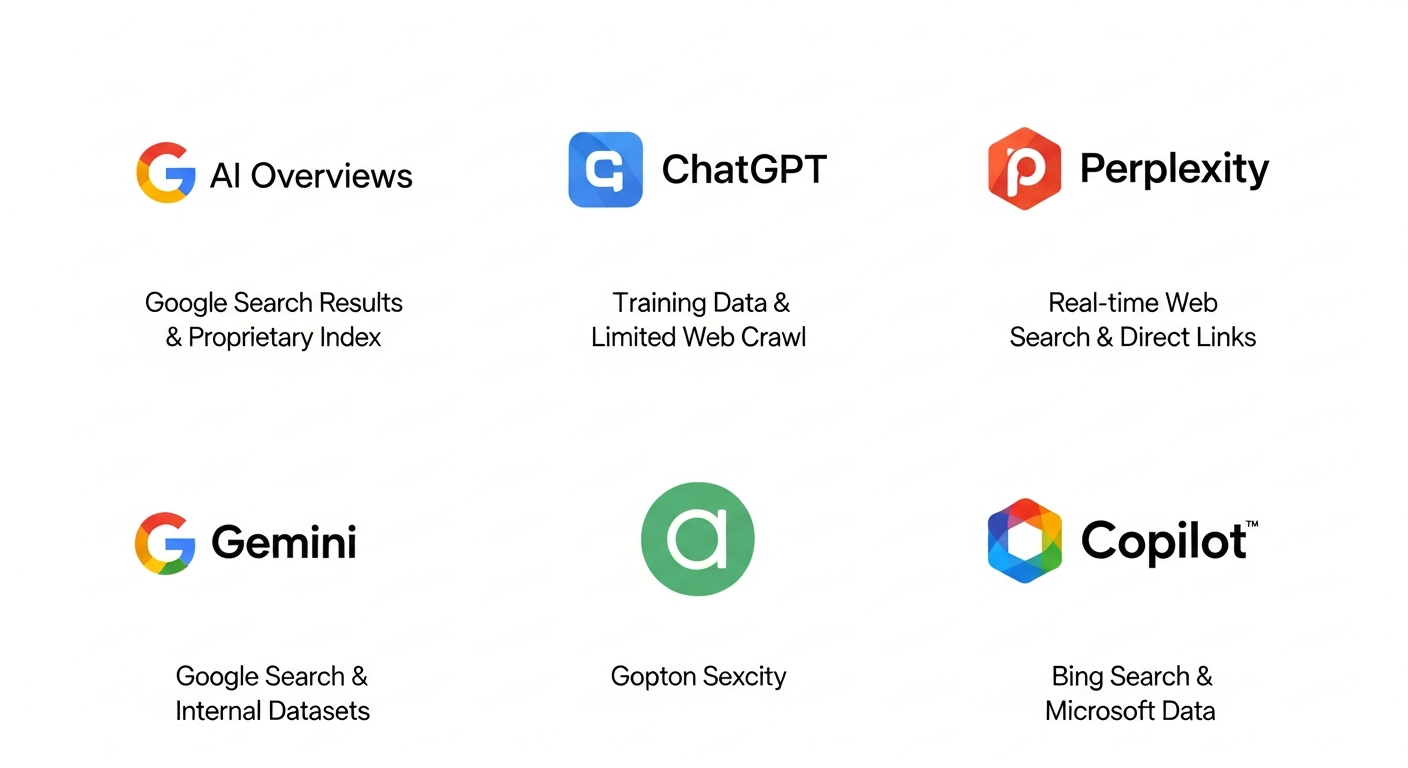
Most AEO guides focus entirely on Google AI Overviews. That is a narrow view. ChatGPT alone has 800 million weekly active users, up from 300 million in December 2024 (OpenAI via RevvGrowth, 2025). Each major AI platform has distinct citation behaviors. Optimizing only for one means being invisible on the others.
Platform Citation Behaviors
Google AI Overviews prioritize pages that already rank well organically, have structured data, and demonstrate topical authority. Strong E-E-A-T signals are weighted heavily. FAQ schema has a documented 3.2x citation advantage.
ChatGPT (with Browse and the underlying training corpus) favors content from high-authority domains, frequently cited sources, and pages with clear entity definitions. It also surfaces content from Bing-indexed pages, making Bing SEO newly relevant.
Perplexity is highly citation-visible. It displays source links prominently, making it one of the highest-intent referral channels available. Perplexity prefers concise, direct answers with verifiable data and explicit source attribution within the content itself.
Gemini integrates Google's Knowledge Graph deeply. Structured data, Google Business Profile optimization, and Wikipedia/Wikidata entity alignment all influence citation likelihood.
Microsoft Copilot draws heavily from Bing and existing Microsoft 365 data. Enterprise brands benefit from ensuring their content is well-indexed on Bing and that their Knowledge Panel information is accurate.
A complete multi-platform AEO strategy requires technical parity (schema, static rendering) combined with platform-aware content calibration.
Citation Capsule: ChatGPT reached 800 million weekly active users by October 2025, up from 300 million in December 2024 (OpenAI via RevvGrowth, 2025). Each major AI platform, including Google AI Overviews, Perplexity, Gemini, and Copilot, has distinct citation behaviors, requiring a differentiated multi-platform AEO strategy rather than a single-channel approach.
Why AEO Is a Revenue Strategy, Not Just a Visibility Tactic
Here is the metric most AEO guides omit entirely. AI-referred traffic converts at 4.4x the rate of standard organic search visitors (Human Agency, 2026). That is not a marginal improvement. That is a different category of buyer.
When a user finds your brand through an AI citation, they arrive with context already established. The AI has already explained what your product does, why it is relevant, and often why it is credible. The trust work is done before the visit.
The B2B AI Citation Gap
This conversion advantage has a specific implication for B2B brands that almost no one is discussing. Enterprise buyers now routinely use AI platforms to research vendors before ever visiting a website. They are asking ChatGPT to recommend tools, asking Perplexity to compare solutions, and asking Gemini to explain category differences.
If your brand is not cited in those conversations, you are absent from the consideration set before the buyer journey has formally begun. This is the AI citation gap, and it is actively costing pipeline.
The global AI search engine market was $16.30 billion in 2025 and is projected to reach $182.17 billion by 2035 at a 27.3% CAGR (Precedence Research, 2025). The brands that build AI visibility now will have structural advantages that compound as the market grows.
Furthermore, 44% of AI-powered search users now consider AI their primary source of insight, versus only 31% who still rely most on traditional search (McKinsey via RevvGrowth, 2025). Your buyers are already there. The question is whether your content is.
Citation Capsule: AI-referred traffic converts at 4.4x the rate of standard organic search visitors (Human Agency, 2026), positioning answer engine optimization as a revenue strategy rather than a visibility exercise. This conversion premium exists because AI citations pre-establish brand context and credibility before the user ever visits a website.
How to Measure AEO Performance: The AI Visibility KPI Stack
Traditional SEO metrics, rankings, impressions, organic sessions, do not capture AEO performance. AI citations often drive zero measurable clicks while still building brand authority and influencing purchase decisions. You need a different measurement framework.
Here is a practical AI Visibility KPI stack built for 2026:
Core AEO Metrics
AI Citation Share: The percentage of tracked prompts (relevant to your category) where your brand is cited. Track this across ChatGPT, Perplexity, and Google AI Overviews weekly.
Prompt Coverage Rate: How many of your target questions (mapped to the buyer journey) return content from your domain in AI responses? Start with 20-30 priority prompts and expand from there.
AI-Referred Sessions: Segment this in GA4 using source/medium filters for known AI referrers (perplexity.ai, chatgpt.com, bing.com via Copilot). Monitor conversion rate separately from organic traffic.
AI-Referred Conversion Rate: As noted, this should be substantially higher than standard organic. If it is not, your post-click experience may be creating friction that erases the pre-established trust.
Share of AI Voice: In your category, how often is your brand mentioned versus competitors in AI-generated responses? This is a share-of-market metric, not just a traffic metric.
Supporting Diagnostic Metrics
Schema implementation rate across key pages
FAQ-schema-eligible pages indexed correctly in Google Search Console
Bing indexation rate (critical for ChatGPT and Copilot visibility)
Page load performance for static HTML delivery
AI Parsing Success Rate: Schema vs. No Schema
You can check your current AI visibility baseline at airix.app/lp/invisible-to-ai to see where gaps exist before building your tracking framework.
Citation Capsule: A complete AEO measurement framework includes AI Citation Share (citation rate across tracked prompts), Prompt Coverage Rate (buyer journey question coverage), AI-Referred Session volume, and Share of AI Voice (competitive mention share in AI responses). These metrics capture AI visibility performance that traditional SEO analytics, focused on rankings and clicks, cannot measure.
Does AEO Replace SEO? How They Work Together in 2026
AEO does not replace SEO. Gartner predicts 25% of traditional search volume will shift to AI chatbots and virtual agents by end of 2026 (Gartner cited by Bullseye Strategy, 2025). That still leaves 75% on traditional search. Abandoning SEO would be premature. But treating it as your only strategy is now equally risky.
The practical integration looks like this: SEO builds the domain authority and indexation signals that AI systems use as credibility inputs. AEO builds the structural and schema signals that make content extractable once the AI visits your page.
A Unified Content Framework
Strong SEO without AEO means you rank but you are not cited. Your content attracts the crawler but frustrates the AI model trying to extract a clean answer.
Strong AEO without SEO means your content is well-structured but low-authority. AI systems weight domain credibility heavily. A beautifully formatted answer on a low-authority domain loses to a messier answer on a high-authority one.
The unified approach optimizes both layers simultaneously:
Build topical authority through comprehensive SEO content clusters
Structure each page for AI extraction with schema, answer-first formatting, and FAQ blocks
Earn citations through data-driven, original research that AI models treat as authoritative sources
Monitor both rankings and citation share as parallel success metrics
AI-referred sessions grew 527% year-over-year between January and May 2025 (Frase.io citing Relixir data, 2025). That growth rate indicates where the marginal return on content investment is shifting, but it does not indicate that traditional search is irrelevant.
Citation Capsule: Gartner predicts 25% of traditional search volume will shift to AI chatbots and virtual agents by end of 2026 (Gartner cited by Bullseye Strategy, 2025). This projection confirms that AEO and SEO must operate as complementary disciplines, with SEO building the authority signals that AI systems use as credibility inputs and AEO building the structural signals that enable content extraction.
Getting Started: Your AEO Implementation Checklist
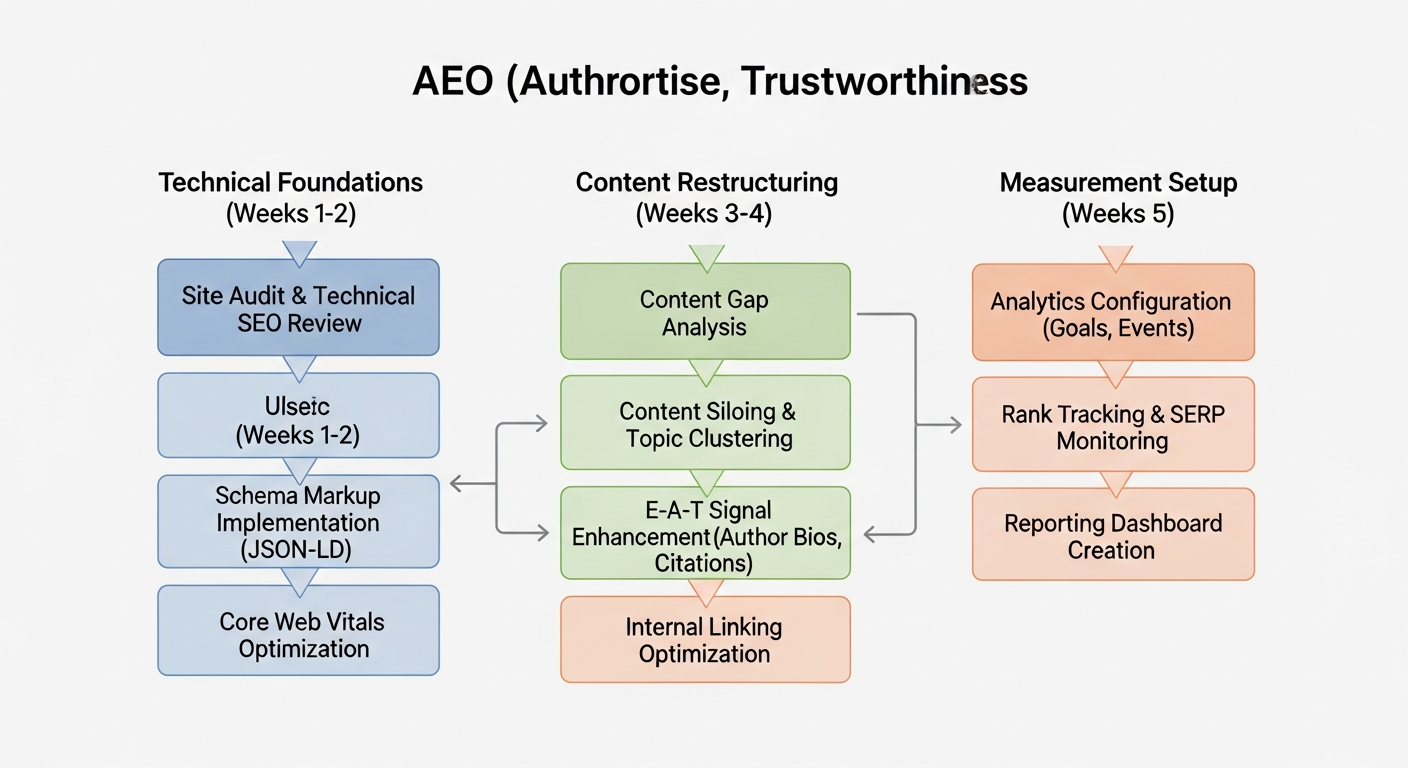
Building AEO capability does not require rebuilding your entire content operation. Start with these concrete actions:
Technical Foundations (Weeks 1-2)
Audit your top 20 pages for AI parseability. Check whether they use static HTML or require JavaScript rendering. Remember: static HTML with schema achieves 94% AI parsing success versus 23% for JS-rendered content without schema (Erlin, 2026).
Add FAQPage schema to all major content pages. This single action has a 3.2x citation advantage for Google AI Overviews (Frase.io / Erlin, 2025).
Verify Bing indexation. ChatGPT and Copilot use Bing's index. Many brands are indexed on Google but missing from Bing entirely.
Content Restructuring (Weeks 3-4)
Rewrite your top 10 pages using answer-first formatting. Every H2 section should open with a 40-60 word direct answer. Move supporting context, data, and examples after the lead answer.
Map 20-30 priority prompts across your buyer journey. What questions are your customers asking AI platforms right now? Structure content to answer each one definitively.
Add explicit entity definitions for your brand, products, and key concepts. AI systems need clear entity signals to cite you accurately across different platforms.
Measurement Setup (Week 5)
Configure GA4 to segment AI-referred traffic separately. Set up the AI Visibility KPI stack outlined in the previous section. Establish a weekly prompt-testing routine across ChatGPT, Perplexity, and Google.
Citation Capsule: A foundational AEO implementation prioritizes three technical interventions: migrating to static HTML with schema markup (improving AI parsing success from 23% to 94%), adding FAQPage schema to top content pages (yielding a 3.2x Google AI Overview citation advantage), and verifying Bing indexation for ChatGPT and Copilot visibility (Erlin, 2026).
Frequently Asked Questions About Answer Engine Optimization
Q: What is the difference between AEO and traditional SEO?
AEO optimizes content for AI citation and extraction, while SEO optimizes for keyword rankings and organic click-through. The average AI prompt is 23 words versus 3.37 words for traditional search queries (The Growth Memo via HubSpot, 2025). AEO content must satisfy complex conversational intent that standard keyword-optimized content is not designed to address.
Q: Does AEO work for small businesses and not just enterprise brands?
AEO can benefit any brand. In fact, smaller brands with highly specific, structured content sometimes outperform larger brands in AI citations on niche queries. With 54%+ of U.S. Google searches now triggering AI Overviews (Ahrefs cited by Bullseye Strategy, 2025), structured content at any scale has citation potential. The technical requirements are consistent regardless of site size.
Q: How quickly does AEO show results?
Technical AEO improvements (schema implementation, HTML structure changes) can show results in 2-4 weeks as AI systems re-crawl and re-index content. Broader citation authority, particularly on ChatGPT and Gemini, builds over months. AI-referred sessions grew 527% year-over-year in early 2025 (Frase.io citing Relixir data, 2025), suggesting a rapidly expanding opportunity for early movers.
Q: What schema markup is most important for AEO?
FAQPage schema is the highest-impact single implementation, with pages using it being 3.2x more likely to appear in Google AI Overviews (Frase.io / Erlin, 2025). After FAQPage, prioritize Article schema (for authorship and date signals), HowTo schema (for process content), and Speakable schema (for voice and AI citation priority).
Q: How do I know if AI systems can currently find my brand?
The most direct method is manual prompt testing: ask ChatGPT, Perplexity, and Google directly about your category, competitors, and the problems you solve. Note whether your brand appears. Track citation share across 20-30 relevant prompts weekly. If you want a structured baseline, tools that monitor AI visibility can automate this across multiple platforms and queries.
Conclusion
Answer engine optimization is not the future of search. It is the present reality of how buyers find information in 2026. With 65%+ of searches ending without a click, AI platforms handling 800 million weekly ChatGPT sessions alone, and AI-referred traffic converting at 4.4x the standard organic rate, the question is not whether AEO matters. The question is how much pipeline you are missing by not doing it.
The brands that build AI visibility now, through structured content, schema markup, multi-platform optimization, and consistent citation tracking, are building a compounding advantage as AI search continues its 27.3% annual growth trajectory.
Start by understanding where you stand today. Check your current AI visibility and see exactly which prompts your brand appears in, and which ones you are missing, at AIRIX. The gap between where you are and where your buyers are searching is measurable. And it is closable.