We'll check if ChatGPT, Gemini, and Claude can actually read your website. Takes 30 seconds.
By submitting, you agree to receive your report and occasional emails. Unsubscribe anytime.
Ready to see where you stand?
Get a free AI crawlability audit - robots.txt, SSR, llms.txt, structured data and more. Sent straight to your inbox.
By submitting, you agree to receive your report and occasional emails. Unsubscribe anytime.
Perplexity AI Optimization: Appear in Results in 2026
Perplexity AI processed 780 million search queries in May 2025 alone — nearly tripling from 230 million just a year earlier (Perplexity CEO Aravind Srinivas via index.dev, 2025). That growth represents a massive, largely untapped traffic channel that most brands have no strategy for.
This guide gives you a step-by-step system for Perplexity AI optimization: from getting your site crawled, to structuring content for citations, to tracking your performance over time.
By the end, you will know exactly what Perplexity's ranking system rewards — and how to give it what it wants.
Key Takeaways
Perplexity weights content freshness at 40% of its ranking signal — recency is the single biggest lever
46.7% of Perplexity's top citations come from Reddit — off-site presence is non-negotiable
Only 11% of domains are cited by both ChatGPT and Perplexity — platform-specific strategies matter
Brands present on 4+ third-party platforms are 2.8x more likely to be cited
Perplexity AI optimization is not a single tactic. It is a system that combines technical access, content architecture, and off-site signals — all working together.
Perplexity AI Monthly Search Query Volume Growth (2024–2025)
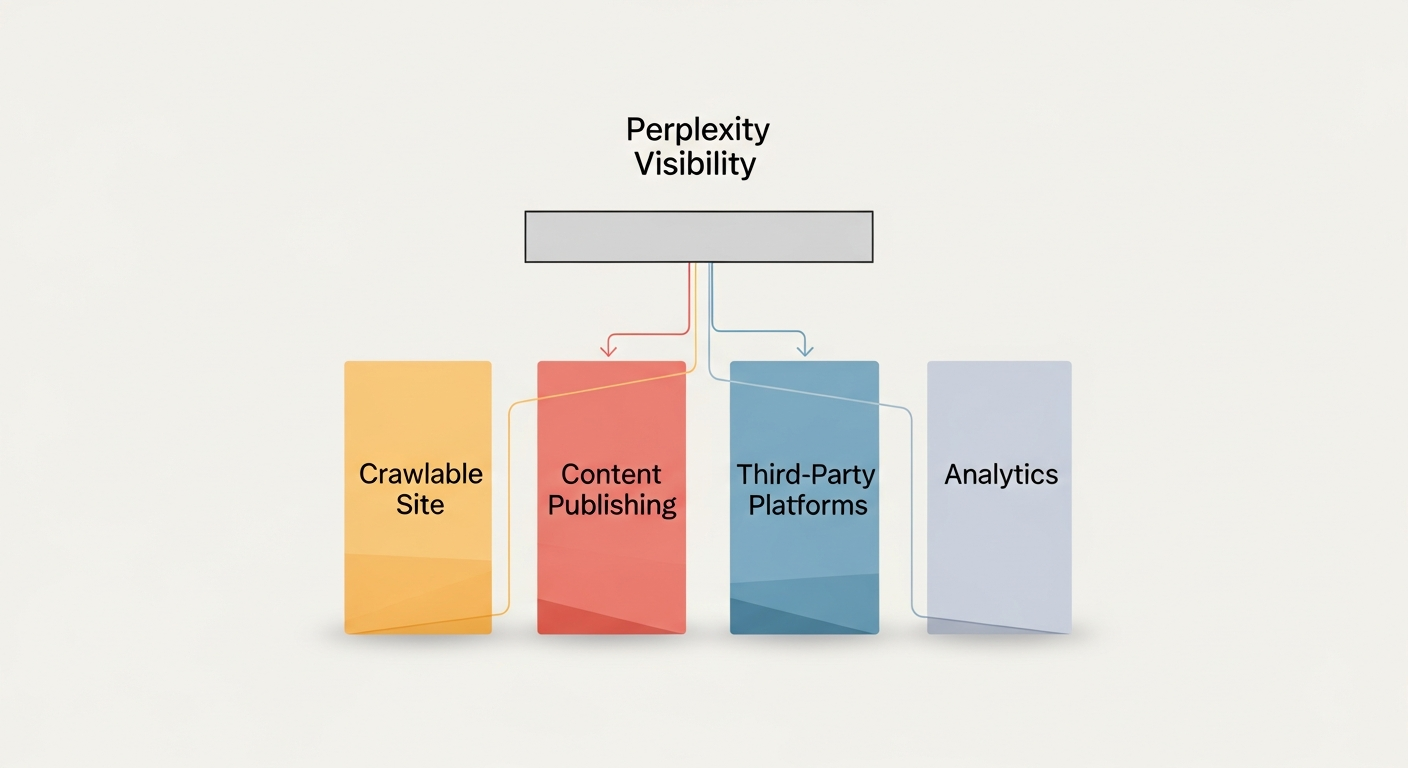
Before jumping into the steps, confirm you have these in place:
A crawlable website. PerplexityBot must be able to access your pages. Check your robots.txt file to ensure you have not blocked AI crawlers.
Content publishing capability. You need to publish and update content frequently. Static sites updated quarterly will struggle.
Third-party platform accounts. Reddit, LinkedIn, YouTube, and niche forums are not optional extras — they are core infrastructure for Perplexity visibility.
Analytics access. You need referral traffic data to measure whether Perplexity is actually sending visitors to your site.
With those foundations in place, here is the step-by-step system.
Step 1: Open Your Site to PerplexityBot
Getting your site crawled by PerplexityBot is the prerequisite for everything else. Without crawl access, no amount of great content will earn you a citation. Many sites accidentally block AI crawlers through generic robots.txt rules designed to stop scraping.
Check your robots.txt file at yourdomain.com/robots.txt. If you see User-agent: * with Disallow: /, you are blocking every bot — including PerplexityBot.
Add this entry to explicitly allow access:
User-agent: PerplexityBot
Allow: /
Also verify your structured data is clean. Perplexity's crawler uses schema markup to understand what type of content a page represents. Add Article, FAQPage, or HowTo schema where appropriate.
Submit your XML sitemap to ensure PerplexityBot can discover your full content inventory. Keep the sitemap updated whenever you publish new content.
Citation Capsule: PerplexityBot, Perplexity AI's web crawler, must be explicitly permitted in a site's robots.txt file to index content for citations. Many sites block it unintentionally through generic crawl rules. Without crawl access, no content optimization effort can yield Perplexity search visibility.
Step 2: Understand How Perplexity Actually Ranks Sources
Perplexity does not use Google's ranking algorithm — it applies its own multi-layer reranking system that weighs factors most SEO tools do not measure. Understanding this architecture is what separates effective Perplexity AI optimization from generic advice.
Perplexity's system works in three layers:
Layer 1: Initial retrieval. Perplexity pulls candidate sources from its index using a combination of keyword relevance and domain authority signals similar to traditional search.
Layer 2: Semantic reranking. The system re-scores those candidates based on how well the content directly answers the user's specific query intent.
Layer 3: Topic multipliers. This is where most competitor guides miss the point entirely. Perplexity applies category-level boosts for content in specific verticals. AI, technology, science, and business content systematically receives higher citation priority than lifestyle or entertainment content.
This means a B2B SaaS brand writing authoritative technical content operates in Perplexity's highest-priority topic category. That is a structural advantage most B2B marketers are not actively exploiting.
Content freshness is also weighted at 40% of the total ranking signal (ConvertMate Perplexity Visibility Study, 2025). In fact, 50% of Perplexity's citations come from content published in 2025 alone — a stark contrast to ChatGPT's reliance on older training data (ConvertMate, 2025).
Perplexity AI: Share of AI Referral Traffic by Platform (Global, 2025)
Step 3: Write Content That Matches Perplexity's Query Intent
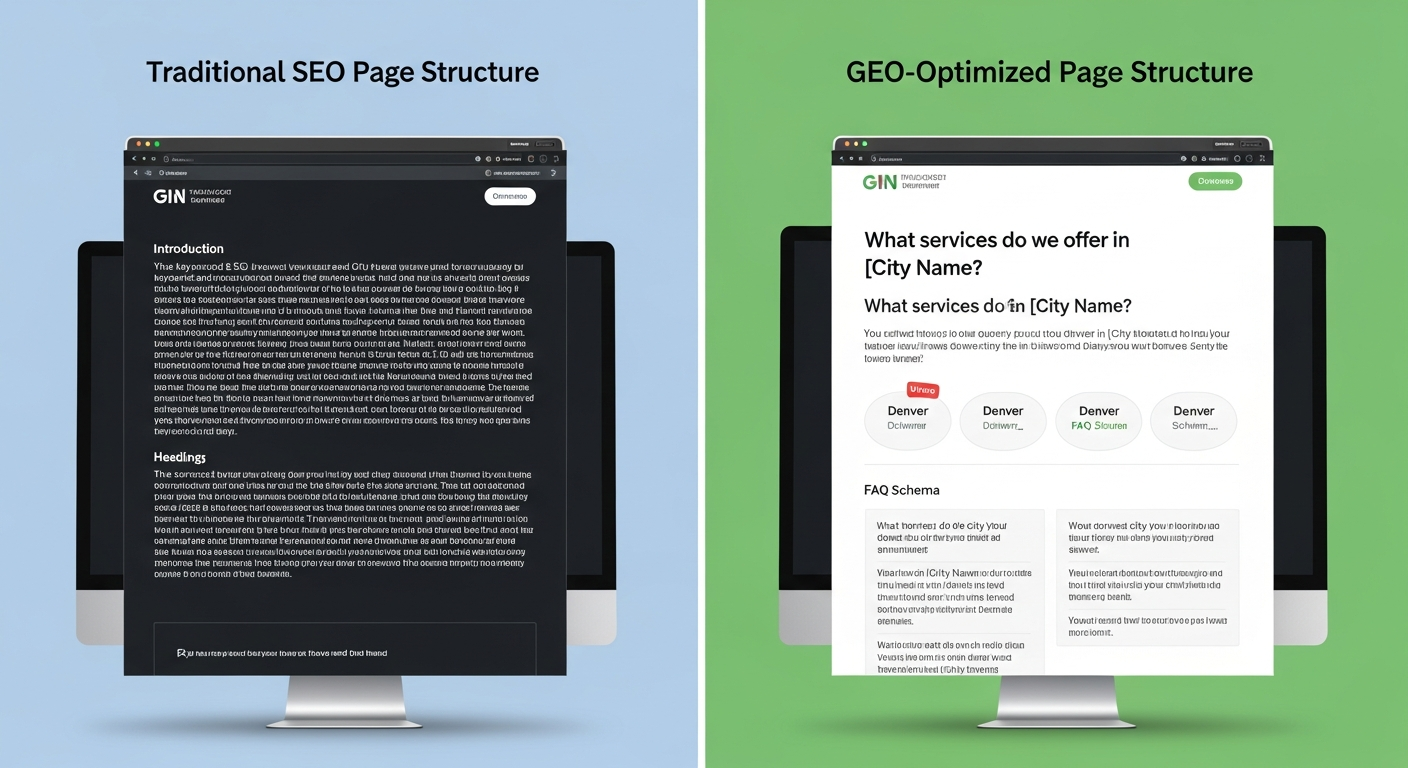
Perplexity users ask questions, and Perplexity rewards pages that answer those questions directly, completely, and without friction. This is the core principle of Generative Engine Optimization (GEO), and it differs from traditional SEO in one critical way: you are optimizing for a machine reader, not a human scanner.
Traditional SEO optimizes for ranking. GEO optimizes for citation. The goal is not to appear at the top of a list — it is to become the source a language model quotes when constructing an answer.
Structure your content with this in mind:
Lead with the answer. Place the direct response to the question in the first 1-2 sentences of each section. Do not bury it in the third paragraph.
Use explicit question-and-answer formatting. H2 headings phrased as questions signal query intent directly to Perplexity's semantic layer.
Add FAQ sections with schema markup. Perplexity's system actively extracts FAQ content. Mark it up with FAQPage schema.
Notably, 29% of all Perplexity queries are academic or research-oriented — the single largest category by intent (Zebracat via SEOProfy, 2025). If your content category overlaps with research, analysis, or industry data, you have a natural advantage. Lead with data, cite your sources visibly, and write with precision.
Step 4: Build Presence Across Perplexity's Focus Modes
Perplexity is not a single search surface — it operates across multiple Focus Modes, each drawing from different source pools. Most optimization guides treat Perplexity as one channel. It is actually five.
The Focus Modes and their implications:
All (default). Draws from the general web index. Standard content and technical optimization applies here.
Academic. Prioritizes peer-reviewed papers, research summaries, and authoritative institutional content. If you publish research, get it cited on platforms like ResearchGate or Google Scholar, or reference primary studies explicitly in your content.
Reddit. This mode is significant. Across all Perplexity queries, 46.7% of top cited sources already come from Reddit (Profound via Wix AI Search Lab, 2025). If your brand is not present in relevant subreddits, you are invisible in a channel that dominates Perplexity's source pool.
YouTube. Perplexity surfaces video content in this mode. Video transcripts are indexed and cited. If your brand produces video, publish transcripts as companion pages on your site.
Writing. This mode prioritizes long-form editorial content, guides, and explanatory articles.
Perplexity's Top Citation Sources by Share of Total Citations (Aug 2024–Jun 2025)
For B2B SaaS brands specifically, the highest-leverage moves are Reddit presence in professional subreddits (r/SaaS, r/startups, r/entrepreneur, vertical-specific communities) and YouTube transcripts for product walkthroughs or thought leadership content.
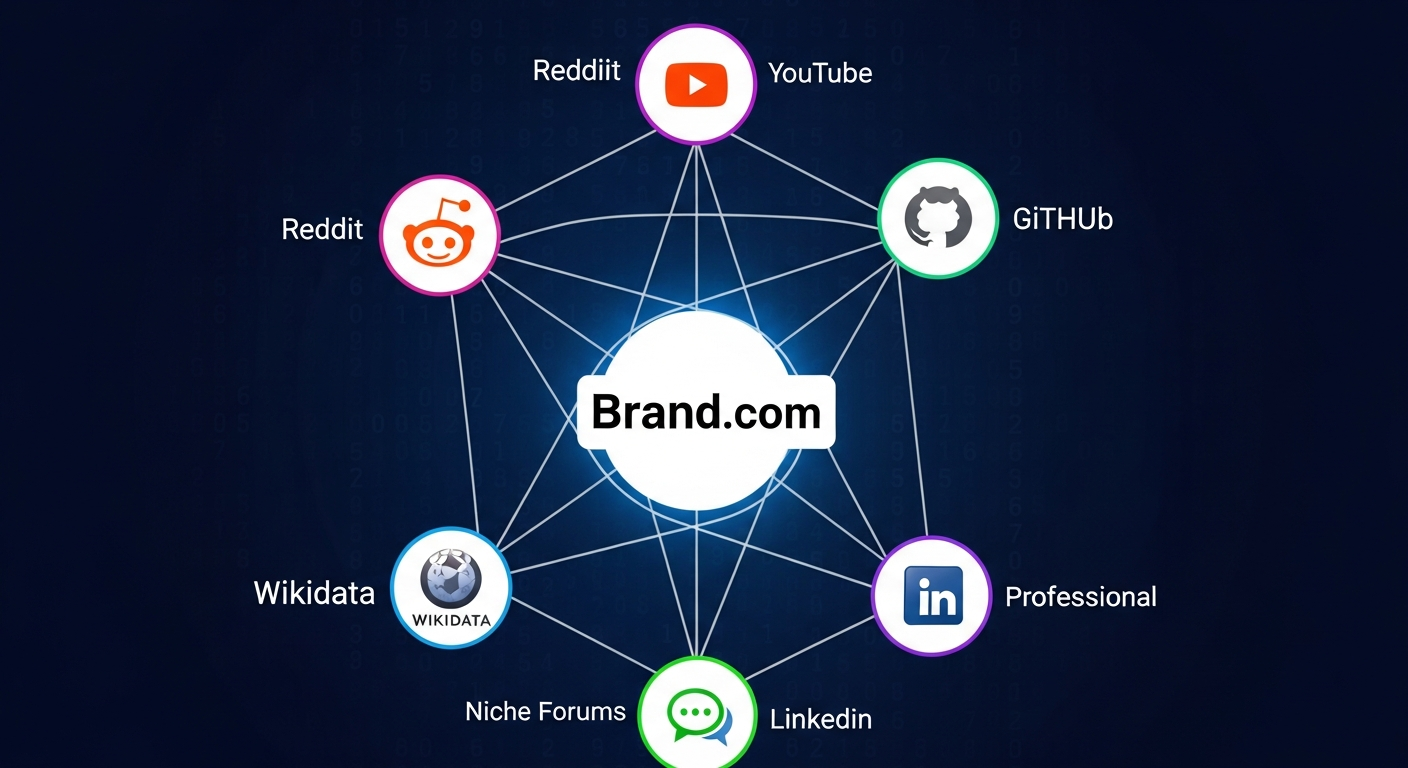
Appearing on your own website is not enough for Perplexity visibility — the platform heavily weights third-party validation signals. Brands that appear across 4 or more third-party platforms are 2.8x more likely to be cited by Perplexity AI (The Digital Bloom 2025 AI Visibility Report, 2025).
The platforms that matter most for Perplexity specifically:
Reddit — non-negotiable given the 46.7% citation dominance
YouTube — especially for technical or product-related content
Wikidata / Wikipedia — provides structured entity signals
GitHub — critical for developer-focused brands
Niche forums and communities — Hacker News, Indie Hackers, Product Hunt, industry Slack communities with public archives
LinkedIn articles — indexed and crawled by Perplexity
This cross-platform strategy also solves a problem that purely SEO-focused brands face: only 11% of domains are cited by both ChatGPT and Perplexity (The Digital Bloom 2025 AI Visibility Report, 2025). Ranking well on Google or appearing in ChatGPT does not transfer automatically. Each platform requires its own citation footprint.
This is a fundamentally different mental model from traditional SEO, and it is why getting your business recommended by ChatGPT requires a separate strategy from Perplexity optimization.
Step 6: Publish and Refresh Content Consistently
Content freshness is Perplexity's single highest-weighted ranking signal at 40% of total score (ConvertMate, 2025) — which means a publishing cadence is not optional for sustained visibility.
The practical implications:
Publish new content at least weekly. Perplexity's recency bias means content published last week outcompetes content published last year, assuming comparable quality and relevance.
Update existing high-value pages. Refresh statistics, add new sections, and update publication dates when you make substantive changes. A meaningful update resets the freshness signal.
Prioritize timely content around industry events. When something significant happens in your space, publish analysis or commentary quickly. Perplexity actively surfaces recent content for time-sensitive queries.
One case study documented a 286% increase in Perplexity-sourced traffic within 6 months of implementing query-intent optimization focused on freshness and direct-answer formatting (ICODA case study via VERTU, 2025). That result required consistency over months — not a single batch of optimized pages.
Citation Capsule: Content freshness accounts for 40% of Perplexity AI's citation ranking signal, according to the ConvertMate Perplexity Visibility Study (2025). Half of all Perplexity citations come from content published in 2025 alone. For sustained Perplexity search visibility, brands must publish and refresh content consistently — not as a one-time effort.
Step 7: Track Your Perplexity Citation Performance
You cannot optimize what you cannot measure — and most brands have no system for tracking Perplexity AI citations. This is one of the largest gaps in the current market for AI search optimization tools, and it is where brands that get systematic separate themselves from those guessing.
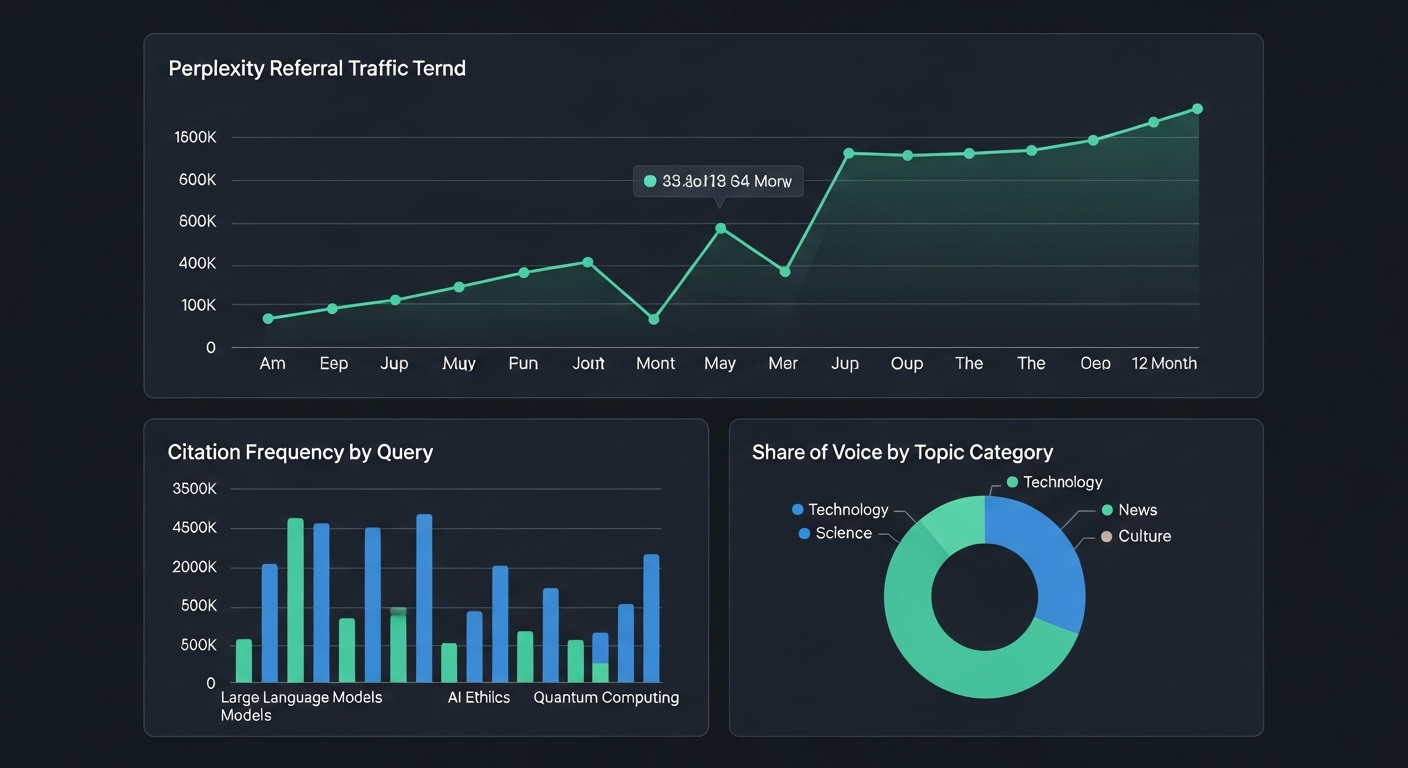
Here is what to track and how:
Referral traffic from Perplexity. In Google Analytics 4 or your analytics platform, segment referral traffic from perplexity.ai. Track session volume, pages landed on, and conversion behavior. Perplexity currently drives 15.1% of all AI referral traffic globally, second only to ChatGPT's 77.97% (SE Ranking AI Traffic Research Study, 2025).
Citation frequency by query. Manually test target queries in Perplexity and record whether your domain appears in citations. Track this weekly for your top 20-30 target queries.
Share of voice across query categories. Map which content types earn citations versus which do not. This reveals gaps in your topic coverage.
Third-party mention velocity. Track how often your brand appears in Reddit threads, forum discussions, and external content — the upstream signals that feed Perplexity's citation model.
Common Mistakes That Kill Perplexity Visibility
Even well-intentioned optimization efforts fail for predictable reasons. Avoid these:
Blocking PerplexityBot in robots.txt. This is the most common technical error. Many sites use broad bot-blocking rules that catch Perplexity's crawler.
Treating Perplexity like Google. Optimizing title tags and meta descriptions does not move Perplexity citations. The content itself — its structure, directness, and freshness — is what matters.
Ignoring Reddit entirely. Given that Reddit represents 46.7% of Perplexity's top cited sources, brands with zero Reddit presence are operating without their most important citation channel.
Publishing once and waiting. The 40% freshness weighting means stale content actively loses visibility over time, regardless of its initial quality.
Copying ChatGPT optimization tactics. Only 11% of domains cited by ChatGPT are also cited by Perplexity. What works on one platform does not automatically work on the other. If you are unsure how visible you are across AI platforms, check if AI can find you before assuming your current strategy covers both.
Perplexity Ranking Factor Weight Breakdown
FAQ
Q: How does Perplexity AI decide which sources to cite in its answers?
Perplexity uses a three-layer system: initial keyword-based retrieval, semantic reranking by query intent, and topic-level multipliers that boost AI, tech, science, and business content. Content freshness drives 40% of the ranking signal, according to the ConvertMate Perplexity Visibility Study (2025). Direct-answer formatting and third-party platform presence also significantly influence citation selection.
Q: Does ranking #1 on Google guarantee visibility in Perplexity AI results?
No. Perplexity and Google use entirely different ranking systems. Only 11% of domains are cited by both ChatGPT and Perplexity, confirming that AI search visibility requires platform-specific strategies (The Digital Bloom 2025 AI Visibility Report, 2025). A page can rank first on Google and never appear in Perplexity citations — and vice versa.
Q: What is Generative Engine Optimization (GEO) and how does it differ from SEO?
GEO optimizes content to be cited by AI systems, not just ranked in traditional search results. Where SEO targets ranking positions, GEO targets citation frequency. The formatting requirements differ significantly: GEO prioritizes direct answers, question-format headings, and structured data. Perplexity AI processed 780 million queries in May 2025 (index.dev, 2025), making GEO an increasingly critical skill.
Q: Does Reddit really matter that much for Perplexity visibility?
Yes — more than any other single platform. Across Perplexity's top cited sources, 46.7% come from Reddit (Profound via Wix AI Search Lab, 2025). This is not a marginal signal — it reflects Perplexity's deliberate prioritization of community-based, experiential content. Brands without a genuine Reddit presence are missing nearly half of Perplexity's primary citation pool.
Q: How long does it take to see results from Perplexity AI optimization?
Timelines vary, but one documented case study recorded a 286% increase in Perplexity-sourced traffic within 6 months of systematic optimization (ICODA case study via VERTU, 2025). Given Perplexity's 40% weighting on content freshness, early gains on recently published content can appear within weeks. Sustained citation authority across multiple query categories typically takes 3-6 months of consistent effort.
Conclusion
Perplexity AI has 45 million monthly active users as of late 2025 (Business of Apps, 2025) and an 85% user retention rate. This is not an experimental platform — it is an established search channel with a distinct ranking architecture that rewards freshness, direct-answer formatting, and cross-platform presence.
The brands that win on Perplexity in 2026 will not be those with the highest Google rankings. They will be the ones that understand the freshness bias, build genuine Reddit presence, optimize for Focus Modes specifically, and track citation performance with the same rigor they apply to organic search.
The system outlined in this guide works. The 286% traffic increase case study proves it — but only for brands that execute consistently over months, not days.
If you want to know where you currently stand across AI search platforms before implementing these steps, AIRIX tracks your citation frequency, share of voice, and referral performance across Perplexity, ChatGPT, and other AI systems — so you can measure what is working and close the gaps that are costing you visibility.