Complete Guide to AI Visibility for Businesses in 2026
AIRIX Team··21 min read
Want to know your AI visibility score?
We'll check if ChatGPT, Gemini, and Claude can actually read your website. Takes 30 seconds.
By submitting, you agree to receive your report and occasional emails. Unsubscribe anytime.
Ready to see where you stand?
Get a free AI crawlability audit - robots.txt, SSR, llms.txt, structured data and more. Sent straight to your inbox.
By submitting, you agree to receive your report and occasional emails. Unsubscribe anytime.
Complete Guide to AI Visibility for Businesses in 2026
AI-driven traffic to U.S. retail sites grew 393% year-over-year in early 2026, and that traffic converts 42% better than non-AI channels (Adobe Digital Insights, 2026). If your business is not showing up inside ChatGPT, Perplexity, or Google AI Overviews, you are handing those conversions to competitors who are.
This guide covers everything a business owner or marketing leader needs to know about AI visibility in 2026 — what it is, why it matters, and exactly how to build it.
Key Takeaways
60% of searches now end without a click (Bain & Company, 2025)
ChatGPT referral traffic converts at 7.1% — ahead of organic search and email
84% of brands do not track their AI visibility at all (McKinsey, 2025)
GEO strategies produce 30-40% visibility improvements in 60-90 days
$750 billion in U.S. consumer revenue will flow through AI-powered search by 2028
What Is AI Visibility, and Why Does It Matter in 2026?
44% of AI-powered search users say AI is their primary source of insight for purchase decisions (McKinsey, 2025). AI visibility is how often and how prominently your brand appears inside AI-generated answers across platforms like ChatGPT, Perplexity, Gemini, and Google AI Overviews. It is not the same as your Google ranking.
AI vs. Traditional Search: Consumer Preference for Purchase Decisions
Traditional SEO measures your position on a results page. AI visibility measures whether AI models choose to mention, recommend, or cite your business when someone asks a relevant question.
That distinction carries serious business consequences. If an AI answers "What is the best accounting software for a 10-person company?" without mentioning you, the search session often ends there. No click, no visit, no sale — and you will never know it happened.
Citation Capsule: AI visibility measures brand presence inside AI-generated answers, not search engine rankings. With 44% of AI search users relying on AI summaries for purchase decisions (McKinsey, 2025) and 60% of searches ending without a click (Bain & Company, 2025), AI visibility has become a primary business metric for 2026.
How Big Is the AI Search Opportunity for Businesses?
McKinsey projects $750 billion in U.S. consumer revenue will flow through AI-powered search by 2028 (McKinsey & Company, 2025). That number alone justifies treating AI visibility as a line item in your marketing strategy, not an afterthought.
The conversion data reinforces the urgency. ChatGPT referral traffic already converts at 7.1% (Similarweb, 2026), placing it second only to paid search among all traffic channels. Organic search, social, email, and display all trail behind it.
There is also a compounding advantage for early movers. Brands cited inside AI-generated answers earn approximately 120% more organic clicks per impression than uncited competitors on the same query (Seer Interactive, 2026). Getting cited builds more visibility, which generates more citations.
AI Traffic Conversion Rate by Channel (2026)
Citation Capsule: ChatGPT referral traffic converts at 7.1%, second only to paid search at 7.8% and ahead of every other traffic channel including organic search, email, and social media (Similarweb, 2026). With McKinsey projecting $750 billion in U.S. consumer revenue flowing through AI search by 2028, AI visibility is now a revenue-critical investment for businesses of any size.
Does Google Rank #1 Still Mean AI Visibility?
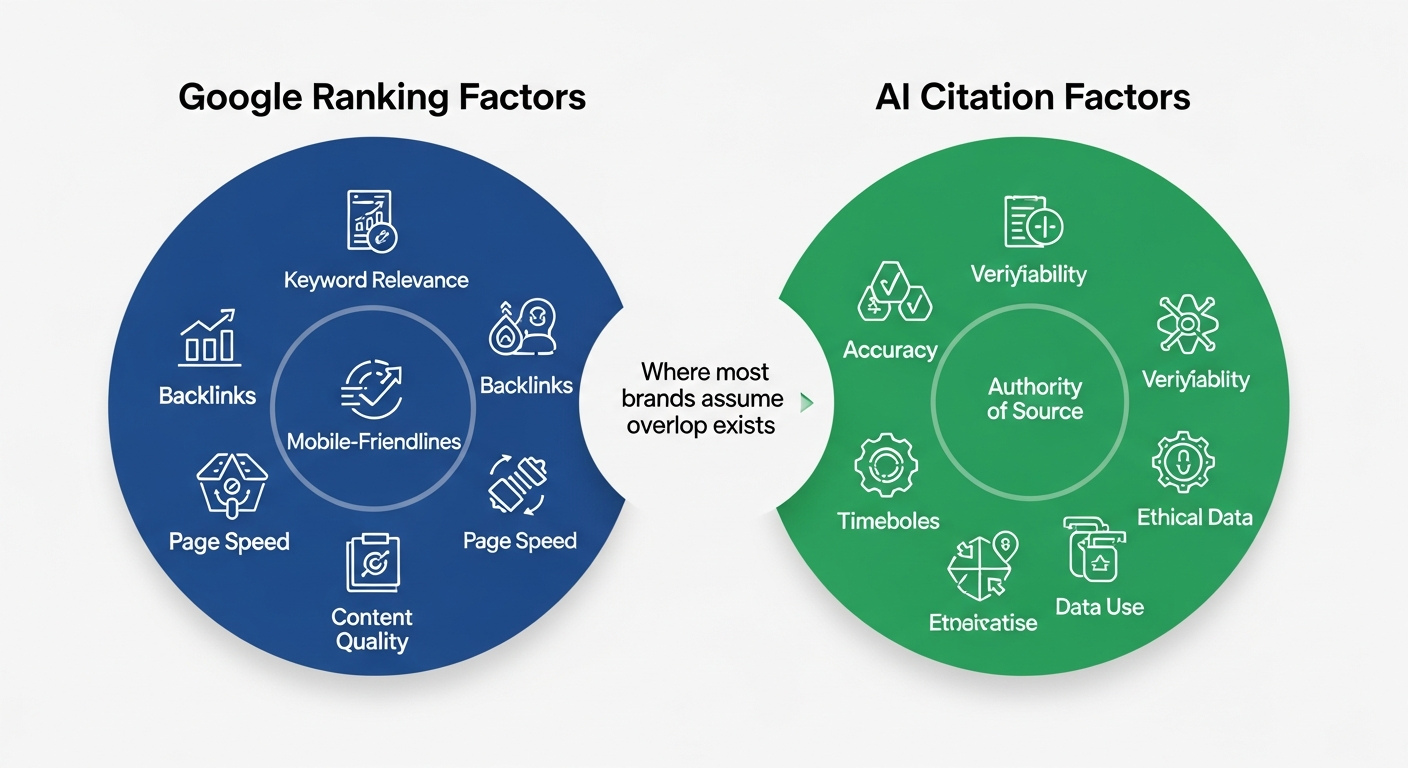
80% of consumers now rely on AI-written results for at least 40% of their searches, reducing organic web traffic by 15-25% for unprepared brands (Bain & Company, 2025). No, your Google rank does not guarantee AI visibility. The two systems use different criteria.
Google ranks pages based on backlinks, authority, and keyword relevance. AI models select sources based on how clearly content answers a specific question, how trustworthy the source appears, and whether the information is structured for machine readability.
A competitor with fewer backlinks but cleaner, more authoritative content can consistently outperform a #1 Google result inside AI answers. Many businesses discover this when they check if AI can find them for the first time.
Why AI Models Ignore Many Top-Ranking Pages
AI models penalize thin content, content buried in navigation menus, and pages that require JavaScript to render. They also deprioritize content that reads like it was written for keywords rather than for readers.
Structured, direct, factual writing gets cited. Keyword-stuffed landing pages generally do not.
What Is Generative Engine Optimization (GEO)?
Generative Engine Optimization (GEO) is the practice of structuring your content so AI models select it as a source when generating answers. Companies implementing GEO strategies have reported AI visibility improvements of 30-40% within just 60-90 days (Exposure Ninja via QuickSEO.ai, 2026).
GEO differs from traditional SEO in three core ways.
Target: GEO targets AI model training signals and retrieval logic, not search engine crawlers.
Metric: GEO measures citation frequency and share of voice across AI platforms, not keyword rankings.
Content format: GEO prioritizes direct answers, structured data, and authoritative sourcing over keyword density and backlink profiles.
Citation Capsule: Generative Engine Optimization (GEO) optimizes content for selection by AI models rather than for search engine rankings. Businesses implementing GEO have reported AI visibility improvements of 30-40% within 60-90 days (Exposure Ninja via QuickSEO.ai, 2026), making it one of the fastest-return optimization investments available to businesses in 2026.
Core GEO Tactics That Work in 2026
Use clear H2 and H3 headings framed as questions. Write answer-first paragraphs that get to the point in the first two sentences. Add structured data markup (FAQ schema, How-To schema, Organization schema) to your key pages.
Publish original data, case studies, or research your competitors do not have. AI models cite novel, factual information more frequently than derivative content. Learn more in our guide on how AI chatbots decide which businesses to recommend.
AI Chatbot Market Share of Web Referral Traffic (Early 2026)
How Do the Major AI Platforms Differ for Business Visibility?
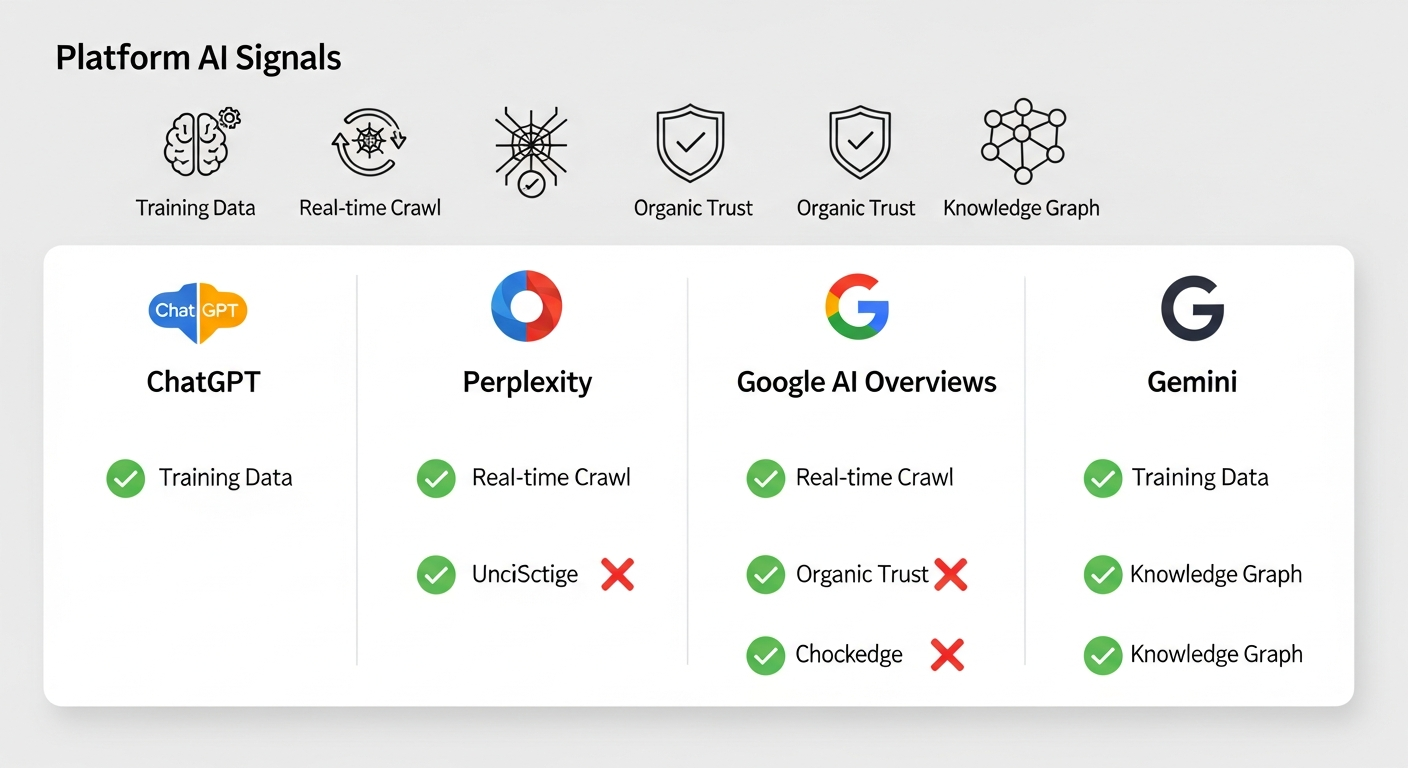
90% of B2B buyers now use generative AI tools during their purchasing journey, with half starting vendor research in ChatGPT or similar platforms instead of Google (Sapt.ai, 2026). Each major AI platform has different citation behavior, which means a single-platform strategy leaves significant visibility on the table.
Here is how each platform operates for businesses today.
ChatGPT (OpenAI)
ChatGPT draws primarily from its training data and, for real-time queries, from Bing search integration. It responds well to structured FAQ content, clear product descriptions, and authoritative third-party mentions on high-domain-authority sites.
Since May 7, 2026, ChatGPT has included clickable brand links directly inside responses. Total ChatGPT referrals to third-party websites increased 157.7% week-over-week immediately after this change (Similarweb, 2026). Being cited now carries a direct traffic dividend.
Perplexity AI
Perplexity functions more like a real-time search engine. It actively crawls and cites sources within responses. Freshly published, clearly structured content with explicit source attribution performs well here.
Google AI Overviews (formerly SGE)
Google AI Overviews pull primarily from pages Google already trusts in organic search, but with a bias toward content that answers the query in the first 100 words. Structured data markup and concise answer paragraphs give your pages the best chance of inclusion.
Gemini (Google DeepMind)
Gemini integrates tightly with Google's knowledge graph. Strong Google Business Profile data, consistent NAP (Name, Address, Phone) information, and presence in authoritative directories significantly improve Gemini citation rates for local and regional businesses.
How Do You Run an AI Visibility Audit?
84% of brands do not systematically track their AI search visibility, making marketing decisions based on incomplete data (McKinsey & Company, 2025). An AI visibility audit closes that gap. You can complete a basic version yourself in under two hours.
Run these five audit steps to establish your baseline across platforms.
Step 1: Query mapping. List the 10-20 questions your ideal customers most likely ask an AI before buying your product or service. Frame them as natural language questions, not keywords.
Step 2: Platform testing. Paste each question into ChatGPT, Perplexity, Google AI Overviews, and Gemini. Record whether your brand appears, what position it appears in, and whether competitors appear instead.
Step 3: Citation source analysis. When your brand appears, identify which page or third-party source the AI cited. This reveals your most visible content assets.
Step 4: Gap analysis. For queries where competitors appear and you do not, analyze their cited content. Identify whether they have better structured answers, stronger third-party mentions, or more authoritative supporting data.
Step 5: Score and track. Assign a simple visibility score: (queries where you appear) divided by (total queries tested), multiplied by 100. Track this monthly. For a deeper framework, see our guide on what an AI visibility score is and why it matters.
Citation Capsule: An AI visibility audit measures how often a brand appears in AI-generated answers across ChatGPT, Perplexity, Gemini, and Google AI Overviews. With 84% of brands not tracking this metric at all (McKinsey, 2025), businesses that run even a basic audit immediately gain a competitive intelligence advantage in AI search.
How Do You Convert AI-Driven Awareness Without a Click?
The zero-click economy is real. 60% of searches now end without the user clicking through to any website (Bain & Company, 2025). Most AI visibility guides treat this as a citation problem to solve. The real question is how to convert brand awareness that never produces a click.
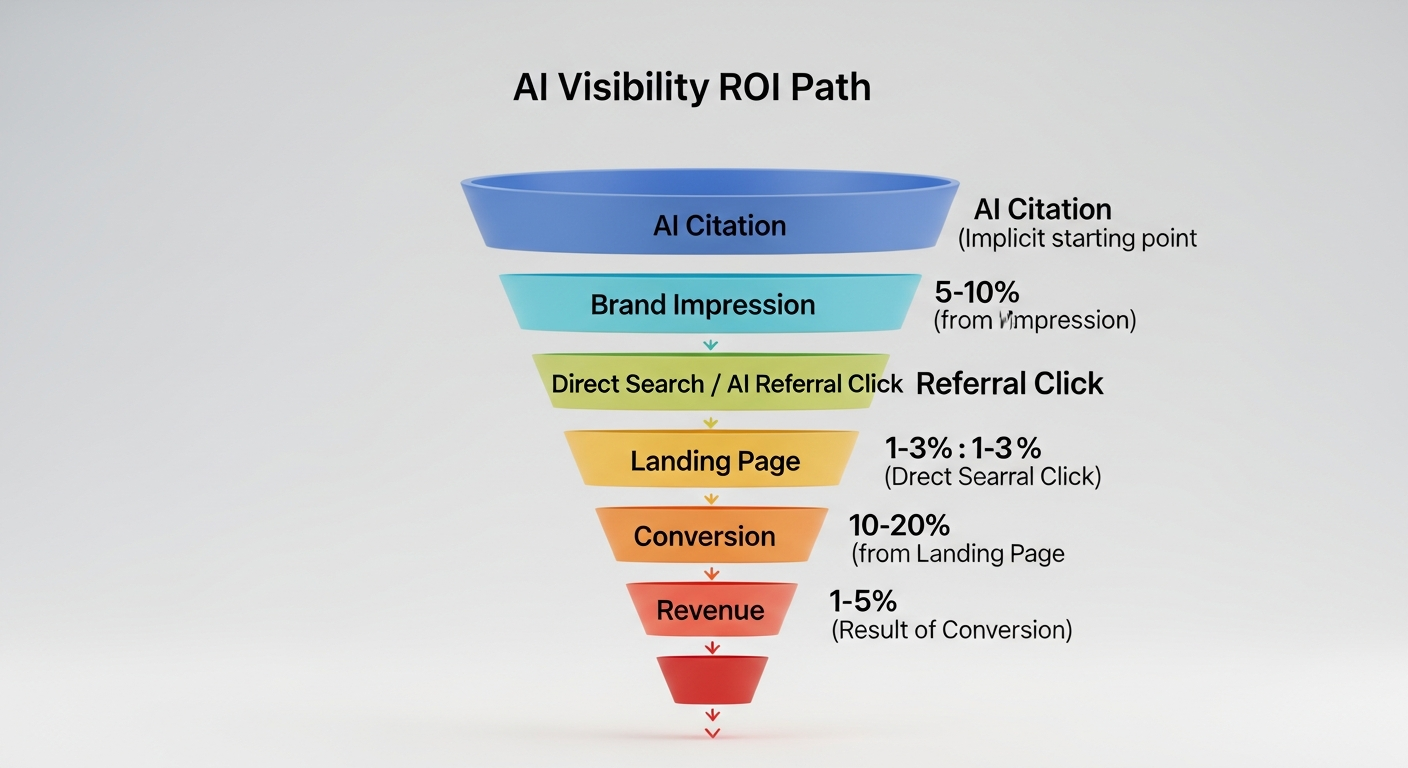
AI citations function like radio advertising used to: they build brand familiarity without direct response. The conversion happens later, through direct search, branded queries, or word-of-mouth referrals. This means the correct attribution model for AI visibility is not last-click. It is brand lift combined with downstream branded search volume.
Three tactics help you capture value from zero-click AI impressions.
Build recall into your positioning. A brand that appears in AI answers with a specific, memorable claim ("the only [category] tool built for [specific use case]") creates a search trigger. Users remember the name and search it directly later.
Track branded search trends. Rising branded search volume after launching GEO efforts is a measurable proxy for AI-driven awareness. Monitor it in Google Search Console monthly.
Create re-entry content. Publish content specifically designed to capture users who heard your name in an AI answer and then searched you directly. This includes clear "what we do" landing pages, comparison pages, and review aggregation pages.
What Content Does AI Actually Cite? A Practical Framework
After analyzing hundreds of AI citations across platforms, a clear pattern emerges. AI models favor content that is structured, specific, and sourced. Generic overview pages rarely get cited. Pages with original data, direct answers, and external validation get cited repeatedly.
The content types AI models cite most often include these categories.
Original research and data. If you publish a survey, benchmark report, or proprietary analysis, AI models treat it as a primary source. This is the highest-leverage content investment for AI visibility.
Direct-answer FAQ content. Pages structured as questions and direct answers map naturally to how AI models retrieve information. Each FAQ item is essentially a pre-formatted AI citation candidate.
Comparison and "best of" content. Users frequently ask AI "what is the best X for Y situation." Detailed, honest comparison content optimized for these queries earns consistent citation across all platforms.
Third-party validation pages. When reputable external sites mention your brand in a factual context, AI models absorb those mentions as trust signals. PR placements, directory listings, and editorial mentions all contribute.
AI Traffic Growth to U.S. Retail Sites (Year-over-Year %)
Is AI Visibility Only for Enterprise Businesses?
Only 19.8% of U.S. businesses overall are actively using AI in any business function (U.S. Census Bureau BTOS Survey, 2026). The majority of AI visibility guides assume enterprise budgets and dedicated content teams. That assumption is wrong, and it represents a major opportunity for small and mid-sized businesses.
Small businesses actually hold a structural advantage in AI visibility: specificity. AI models answer specific questions from specific users. A regional HVAC company that publishes detailed answers to "how much does AC installation cost in [city]" will beat a national brand's generic FAQ every time for that query.
The Information sector leads in AI adoption at 39.7%, followed by Finance & Insurance at 33.9% (U.S. Census Bureau, 2026). Most other sectors, including retail, professional services, and healthcare, remain underpenetrated. Those are the sectors where being an early AI-visible business creates durable competitive moats.
Three SMB-specific AI visibility priorities for 2026:
Claim and optimize Google Business Profile fully. Gemini citations for local businesses rely heavily on this data.
Publish one original data point per quarter. Even a simple customer survey creates citable original research.
Build structured FAQ content around your 10 most common customer questions. These are low-cost, high-return AI citation assets.
Citation Capsule: Only 19.8% of U.S. businesses currently use AI in any business function (U.S. Census Bureau, 2026), creating a first-mover window for small and mid-sized businesses to establish AI visibility before their markets become competitive. SMBs with specific, locally-relevant content can outperform large national brands inside AI-generated answers for targeted queries.
How Do You Measure AI Visibility ROI?
Most businesses track AI visibility as a vanity metric — citation count — rather than connecting it to revenue. This section covers the metrics that actually tie AI visibility to business outcomes.
AI Share of Voice (AI SOV): The percentage of relevant AI-generated answers where your brand appears, divided by the total relevant queries tested. This is your primary AI visibility KPI.
Branded Search Lift: The month-over-month change in branded Google search volume. Rising branded search is a downstream indicator of increasing AI visibility.
AI-Attributed Revenue: Track traffic from known AI referral sources (ChatGPT, Perplexity) separately in your analytics. With ChatGPT referral traffic converting at 7.1% (Similarweb, 2026), even modest AI referral volume carries meaningful revenue impact.
Citation-to-Click Rate: Of the AI citations you receive, what percentage include a clickable link versus a text-only mention? With ChatGPT's May 2026 link update driving 157.7% more referral traffic (Similarweb, 2026), this metric is growing in importance.
Connecting these metrics to your cost-per-acquisition builds the ROI case for continued AI visibility investment. If AI referral traffic converts at 7.1% and your average order value is $500, even 100 AI-referred visitors per month represents $3,550 in revenue at that conversion rate.
Frequently Asked Questions
Q: What is AI visibility for business?
AI visibility for business refers to how often and how prominently a brand appears inside AI-generated answers on platforms like ChatGPT, Perplexity, Gemini, and Google AI Overviews. With 44% of AI search users relying on AI summaries for purchase decisions (McKinsey, 2025), AI visibility directly affects customer acquisition and revenue.
Q: How long does it take to improve AI visibility?
Businesses implementing Generative Engine Optimization (GEO) strategies consistently see AI visibility improvements of 30-40% within 60-90 days (Exposure Ninja via QuickSEO.ai, 2026). Results vary based on content quality, publication frequency, and how competitive your query landscape is across AI platforms.
Q: Does my website need to rank on Google to appear in AI answers?
No. Google ranking helps for Google AI Overviews but is not required for ChatGPT, Perplexity, or Gemini citations. ChatGPT referral traffic alone converted at 7.1% in 2026 (Similarweb, 2026), demonstrating that AI-driven traffic operates independently of traditional organic search rankings.
Q: How do I know if AI can find my business right now?
Run 10-15 of your most common customer questions through ChatGPT, Perplexity, and Google AI Overviews. Record how often your brand appears. This is your baseline AI visibility score. For a structured tracking methodology, see our guide on how to track your AI visibility and mentions.
Q: Is AI visibility important for B2B businesses?
Yes — especially for B2B. 90% of B2B buyers now use generative AI during their purchasing journey, and half begin vendor research in ChatGPT or similar platforms rather than Google (Sapt.ai, 2026). B2B companies not visible in AI answers are invisible at the most critical stage of the buyer journey.
Conclusion: The Visibility Imperative for 2026
The shift is already underway. AI search is not a future trend to plan for — it is the present reality reshaping how customers find businesses, evaluate options, and make purchasing decisions.
The good news is that the window for first-mover advantage is still open. With 84% of brands not tracking AI visibility (McKinsey, 2025) and only 19.8% of U.S. businesses using AI in any capacity (U.S. Census Bureau, 2026), the competitive landscape remains surprisingly open.
Your next step is to know exactly where you stand today. Run an AI visibility audit using the framework in this guide. Identify the queries where you are invisible. Then build the content and structured data that earns your place in AI-generated answers.
AIRIX automates this process — tracking your AI visibility score across ChatGPT, Perplexity, Gemini, and Google AI Overviews in one dashboard. Check your AI visibility score today and find out exactly which AI platforms can find your business and which ones cannot.
Last updated: June 15, 2026. Statistics and platform behaviors are current as of the update date and may change as AI platforms evolve.