AI Search in 2026: Statistics, Trends & What's Next
AIRIX Team··19 min read
Want to know your AI visibility score?
We'll check if ChatGPT, Gemini, and Claude can actually read your website. Takes 30 seconds.
By submitting, you agree to receive your report and occasional emails. Unsubscribe anytime.
Ready to see where you stand?
Get a free AI crawlability audit - robots.txt, SSR, llms.txt, structured data and more. Sent straight to your inbox.
By submitting, you agree to receive your report and occasional emails. Unsubscribe anytime.
AI Search Statistics 2026: Key Trends Reshaping Search
Traditional search is fracturing. For the first time, a meaningful share of online queries never reaches Google at all — they go directly to ChatGPT, Perplexity, and Gemini. Gartner predicted a 25% drop in traditional search volume by 2026 due to AI chatbots, and 2025 data shows that trajectory is on track.
This research brief synthesizes 12 verified statistics from 2025-2026 to map the current state of AI search. The goal is simple: give marketers and brand strategists a factual baseline for decisions in 2026.
Key Takeaways
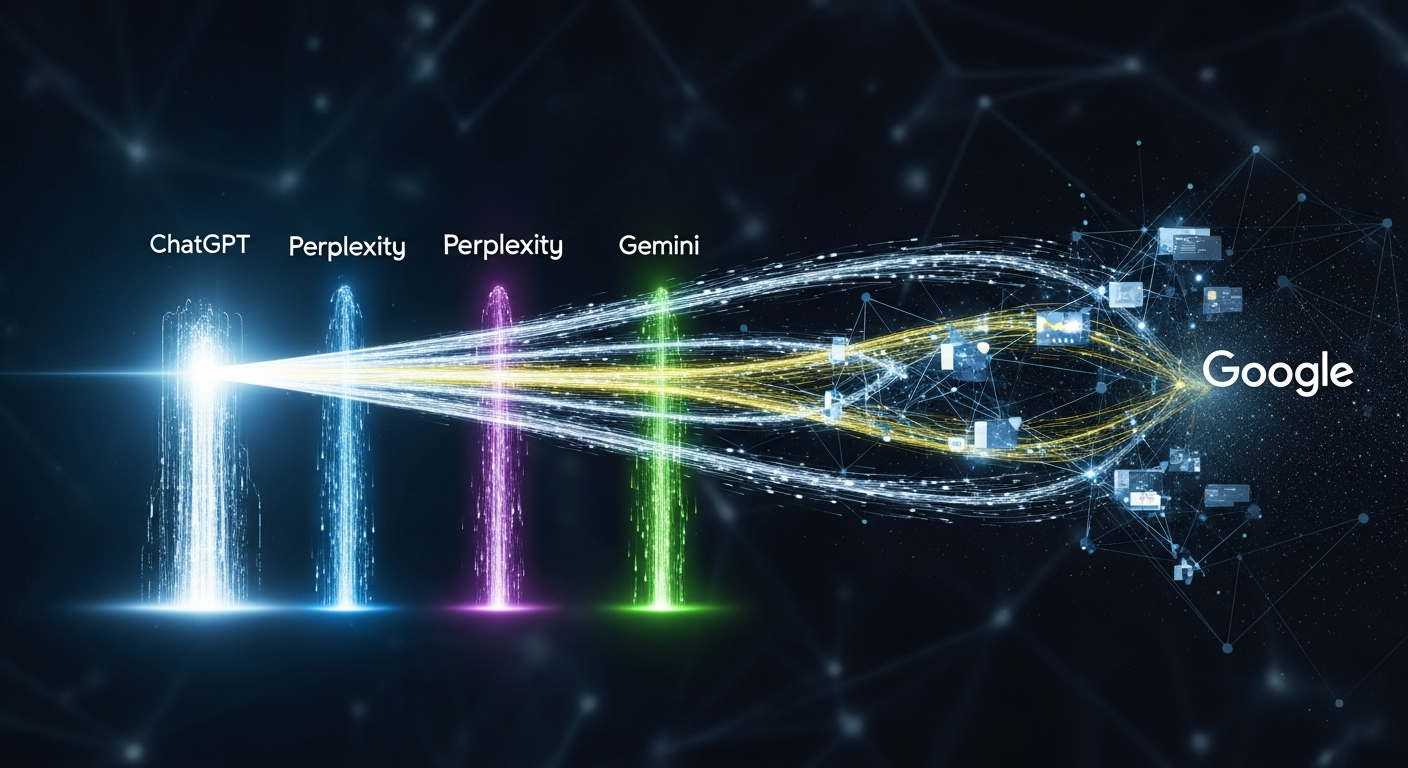
ChatGPT drives over 77% of all AI referral traffic globally
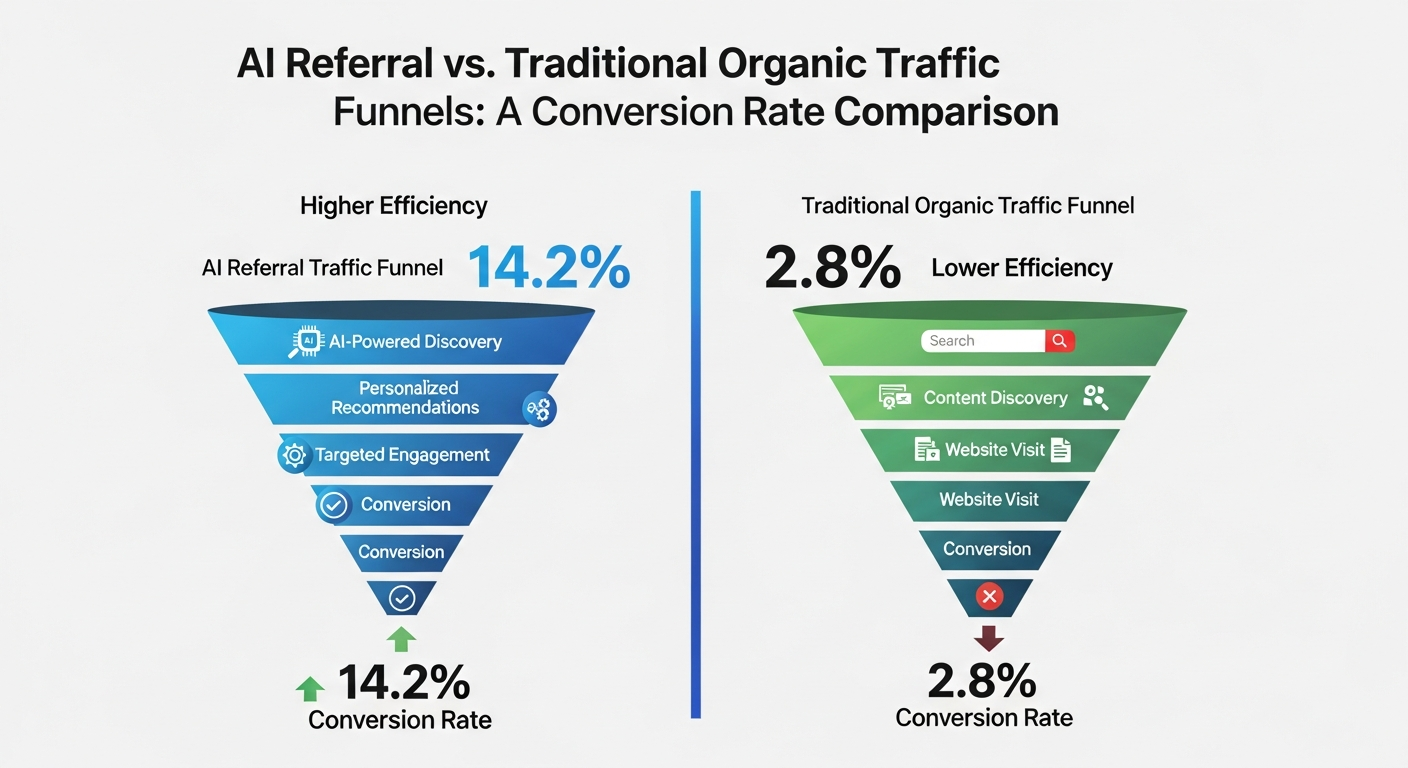
AI-referred visitors convert at 14.2% vs. 2.8% for traditional organic — nearly 5x higher
Google AI Overviews now trigger on 48% of tracked queries, up 58% year-over-year
The global LLM market will grow from $10.57B in 2026 to $149.89B by 2035
31% of Gen Z users now start searches on AI platforms, not Google
AI Search Conversion Rate vs. Traditional Organic Search
All statistics are third-party reported. Where multiple sources cited the same finding, the primary source is preferred. Figures reflect global data unless otherwise noted. This brief does not include proprietary platform-level data.
How Big Is the AI Search Market in 2026?
The LLM market is growing at a rate most industries never see. The global LLM market is projected to grow from $10.57 billion in 2026 to $149.89 billion by 2035, a compound annual growth rate of 34.44% (Precedence Research / GlobeNewswire, 2026). That scale signals infrastructure investment, enterprise adoption, and user migration that won't reverse.
Separately, Gartner projects worldwide generative AI spending reached $644 billion in 2025 — a 76.4% year-over-year jump. Capital at that scale reshapes product roadmaps, publisher relationships, and user habits simultaneously.
Citation Capsule: The global LLM market is projected to reach $149.89 billion by 2035, growing from $10.57 billion in 2026 at a 34.44% CAGR, according to Precedence Research via GlobeNewswire (2026). Generative AI spending hit $644 billion in 2025, a 76.4% increase from 2024 (Gartner, 2025), reflecting broad enterprise and consumer adoption across the AI search ecosystem.
Which AI Platform Sends the Most Referral Traffic?
Perplexity is scaling query volume at a similar pace. The platform processed 780 million monthly queries as of May 2025, tripling from 230 million in mid-2024, with estimates placing it between 1.2 and 1.5 billion monthly queries by mid-2026 (Index.dev, 2026).
The critical strategic implication here is one most coverage misses: ChatGPT and Perplexity share only about 25% of their source recommendations, per GPTrends data. Optimizing for one platform does not automatically transfer visibility to the other. Brands need platform-specific citation strategies, not a single monolithic approach.
Citation Capsule: ChatGPT holds over 77% of AI-driven website referral traffic globally as of early 2026, with 883 million monthly active users (SE Ranking / Exposure Ninja, 2026). Google Gemini grew referral traffic 388% year-over-year in late 2025 (Similarweb via Digiday), while Perplexity processed 780 million monthly queries by May 2025, up 3x from mid-2024 (Index.dev, 2026).
What Is Zero-Click Search Doing to Organic Traffic?
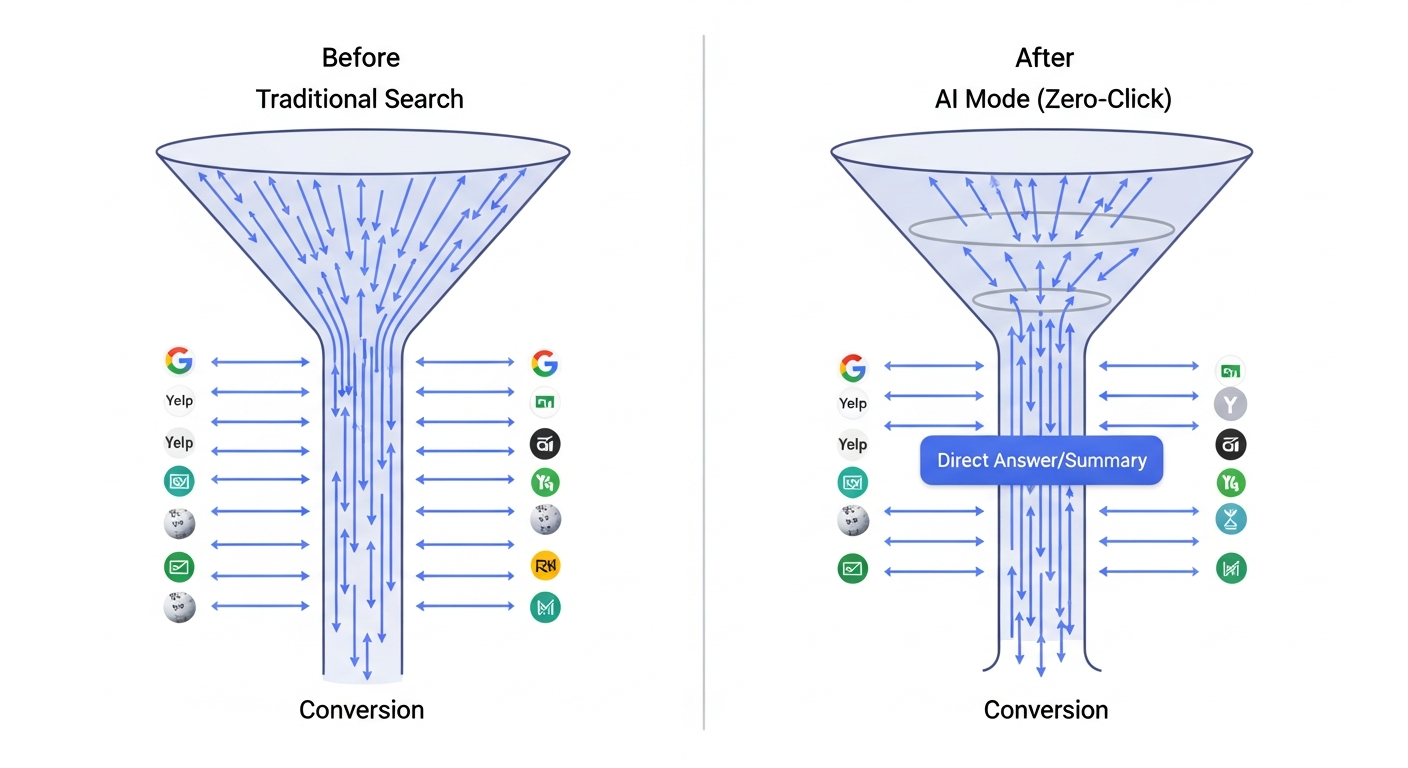
Citation Capsule: Google AI Mode ends 93% of searches without an external click (Semrush, 2025). AI Overviews now appear on 48% of tracked queries — up 58% year-over-year — and have driven a 61% drop in organic CTR for affected queries, from 1.76% to 0.61% (BrightEdge, 2026; Seer Interactive, 2025).
This conversion gap is likely explained by query intent. Users who ask ChatGPT or Perplexity for a product recommendation or service provider are further along in their decision process than someone browsing Google results. They want an answer, not a list.
A straightforward implication follows from this. Even if AI platforms currently send lower absolute traffic volumes than Google organic, the revenue per session from AI-referred visitors may already exceed traditional organic for many businesses.
The ROI math changes the strategic calculus for brand visibility investment.
Citation Capsule: AI search referral traffic converts at 14.2%, nearly five times the 2.8% conversion rate of traditional Google organic search (Sedestral / Exposure Ninja, 2026). For ROI-focused marketers, being cited in AI-generated answers may deliver higher revenue per session than ranking in conventional search results, even at lower traffic volumes.
How Is User Behavior Shifting Toward AI Search?
LLM Global Market Size: 2026–2035 Projection (USD Billions)
This cohort is entering its peak spending years. As Gen Z becomes the dominant consumer demographic through the late 2020s, their default search behavior will define where brands need visibility — not just where they have it today.
Gartner predicted traditional search engine volume would drop 25% by 2026 due to AI chatbots and virtual agents. 2025 data suggests that forecast was directionally accurate, even if exact timing varied by category and geography.
The shift is not uniform across query types. Navigational queries still favor Google. Research, comparison, and recommendation queries — the high-intent categories that drive conversions — are migrating to AI platforms fastest. Brands that understand this distinction can prioritize AI visibility investment where ROI potential is highest.
Citation Capsule: 31% of Gen Z users now start searches on AI platforms or chatbots, versus roughly 20% of the general population (SE Ranking, 2026). Gartner predicted a 25% drop in traditional search volume by 2026 due to AI adoption — a trajectory 2025 data supports — with high-intent research and recommendation queries migrating to AI platforms at the fastest rate.
What Is Answer Engine Optimization (AEO) and How Does It Differ from SEO?
Answer Engine Optimization is the practice of structuring content so that AI systems can extract, cite, and surface it in generated responses. Traditional SEO optimizes for ranking positions in a list of links. AEO optimizes for citation inclusion in a synthesized narrative answer.
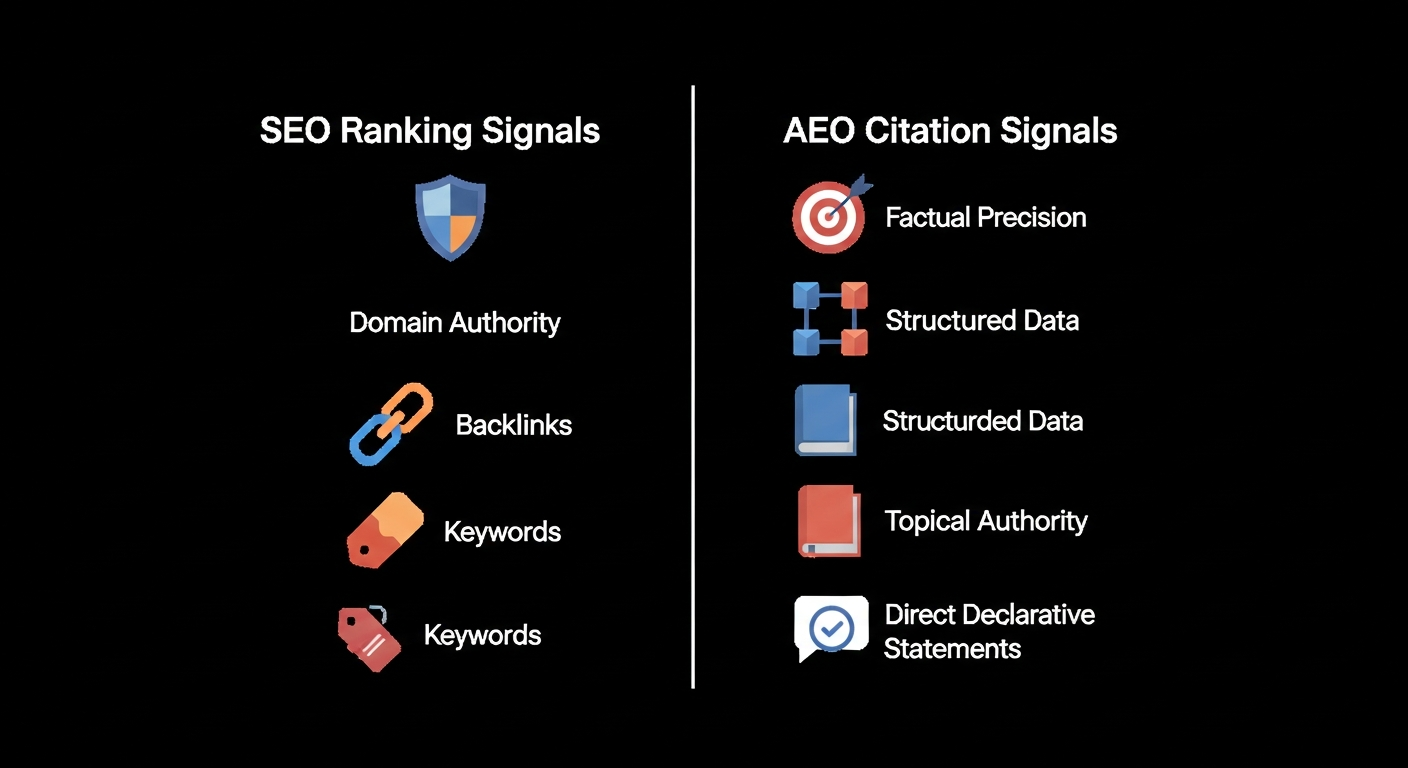
The distinction matters because the ranking signals differ substantially. Traditional SEO rewards domain authority, backlink profiles, and on-page keyword density. AEO rewards factual precision, source credibility, structured data, and topical authority demonstrated through consistent, citable content.
BrightEdge data points to a key structural difference: approximately 62% of AI Overview citations come from sources beyond the traditional top 10 organic rankings. This means a brand that ranks 15th in Google search results can still appear in AI-generated answers — if its content is structured for extraction.
In practice, the content properties that earn AI citations tend to share common features: direct declarative sentences, named statistics with source attribution, clearly scoped factual claims, and authoritative topical clustering. These are not new writing principles, but AI systems reward them more directly than PageRank-era algorithms did.
If your brand doesn't appear in AI-generated answers for your category, you may be invisible to AI entirely — even with strong traditional rankings.
Citation Capsule: Answer Engine Optimization (AEO) differs from SEO by targeting AI citation inclusion rather than link-list rankings. Approximately 62% of AI Overview citations come from beyond the traditional top 10 Google results (BrightEdge, 2026), meaning brands can earn AI visibility without top organic rankings — if their content is structured for machine extraction and factual credibility.
How Should Brands Measure AI Search Visibility?
Traditional analytics tools were not built for AI search. Google Search Console does not track ChatGPT citations. GA4 cannot report on how often Perplexity recommends your brand. The measurement gap is real and growing.
The emerging standard is AI Share of Voice (AI SoV) — the percentage of relevant AI-generated responses that include your brand, measured across platforms and query categories. It mirrors the Share of Voice concept from paid media, applied to LLM citation behavior.
Measuring AI SoV requires systematically querying multiple AI platforms (ChatGPT, Perplexity, Gemini, Claude) with target queries, then recording which brands appear, how frequently, and in what context. At scale, this generates a citation rate benchmark comparable across competitors.
The platform-specific nature of AI citations makes consolidated measurement particularly important. Because ChatGPT and Perplexity overlap only around 25% in their source recommendations, a brand could have strong visibility on one platform and be entirely absent from another. Aggregate AI SoV metrics mask this divergence — platform-level breakdowns are necessary for actionable optimization.
Citation Capsule: AI Share of Voice (AI SoV) is the percentage of AI-generated responses across LLM platforms that cite a given brand for relevant queries. Because ChatGPT and Perplexity share only approximately 25% of their source recommendations (GPTrends data), brands require platform-specific citation tracking across ChatGPT, Perplexity, Gemini, and Claude to identify visibility gaps that aggregate metrics obscure.
Limitations of This Research
Several important constraints apply to this data synthesis.
First, AI platform query volumes and referral traffic figures change rapidly. Statistics from mid-2025 may understate current scale for fast-growing platforms like Perplexity and Gemini.
Second, referral traffic data relies on UTM attribution and analytics configurations that vary across publishers. The 14.2% conversion rate figure is drawn from a limited sample of sites and may not generalize across all verticals or funnel stages.
Third, the zero-click rate figures (93% for Google AI Mode, 61% CTR decline) reflect aggregate behavior across query types. Branded queries, navigational queries, and transactional queries likely behave differently within these averages.
Finally, AI citation measurement remains an emerging practice. No single methodology for tracking AI Share of Voice has achieved industry consensus, and comparisons across tools or studies should be made cautiously.
FAQ
Q: What percentage of searches now use AI instead of Google?
As of 2026, roughly 20% of the general population and 31% of Gen Z users begin searches on AI platforms like ChatGPT or Perplexity rather than traditional search engines (SE Ranking, 2026). Gartner projected overall traditional search volume would drop 25% by 2026 due to this behavioral shift.
Q: Which AI search platform sends the most referral traffic?
ChatGPT sends over 77% of all AI-driven website referral traffic globally as of early 2026, with 883 million monthly active users (SE Ranking / Exposure Ninja, 2026). Google Gemini is the fastest-growing AI referral source, up 388% year-over-year in late 2025 (Similarweb via Digiday, 2025).
Q: How does AI referral traffic compare to organic search in conversion rate?
AI search referral traffic converts at 14.2% versus 2.8% for traditional Google organic search — nearly five times higher (Sedestral / Exposure Ninja, 2026). This conversion premium means that AI-referred visitors generate substantially more revenue per session, even when total visitor volumes remain lower than organic search.
Q: What is the LLM market projected to be worth?
The global LLM market is projected to grow from $10.57 billion in 2026 to $149.89 billion by 2035, representing a 34.44% compound annual growth rate (Precedence Research via GlobeNewswire, 2026). Generative AI spending broadly reached $644 billion in 2025, up 76.4% from 2024 (Gartner, 2025).
Q: Can brands appear in AI search results without top Google rankings?
Yes. Approximately 62% of Google AI Overview citations reference sources outside the traditional top 10 organic results (BrightEdge, 2026). This means brands can earn AI citations through content that is factually precise, clearly structured, and topically authoritative — even without dominant traditional SEO positions.
Conclusion
The data points in one consistent direction: AI search is not supplementing traditional search, it is replacing meaningful portions of it. Google AI Overviews cover 48% of tracked queries. AI Mode ends 93% of sessions without an external click. ChatGPT alone handles 883 million monthly users. And the LLM market will be 14 times larger in nine years than it is today.
For brands, the strategic imperative is visibility inside AI-generated answers — not just rankings in link lists. That requires understanding which platforms cite you, how often, and in what context. It requires tracking AI Share of Voice the way paid media teams track Share of Voice. And it requires structuring content so AI systems can extract and attribute it accurately.
If you want to know where your brand stands today across ChatGPT, Perplexity, Gemini, and Claude, AIRIX tracks your AI citation rate across LLM platforms and shows you exactly where visibility gaps exist. Check your AI Visibility Score to see how your brand appears — or doesn't appear — in the AI answers your customers are reading right now.